Musk Says SpaceX Could Lead AI Race Within Months
The latest Elon Musk said SpaceX could match the performance of leading artificial intelligence systems such as Fable or GPT-6 within two to three months, then become the industry’s top player in roughly six months if its rate of improvement remains strong.
· Originally published by ontime+
Key Points
- Musk predicts SpaceX could match leading AI models in two to three months and rank first within six.
- He argues accelerating improvement could offset its shorter development history against OpenAI and Anthropic.
- Success could reshape competition for chips, energy and infrastructure while expanding AI across aerospace and satellite systems.
The latest
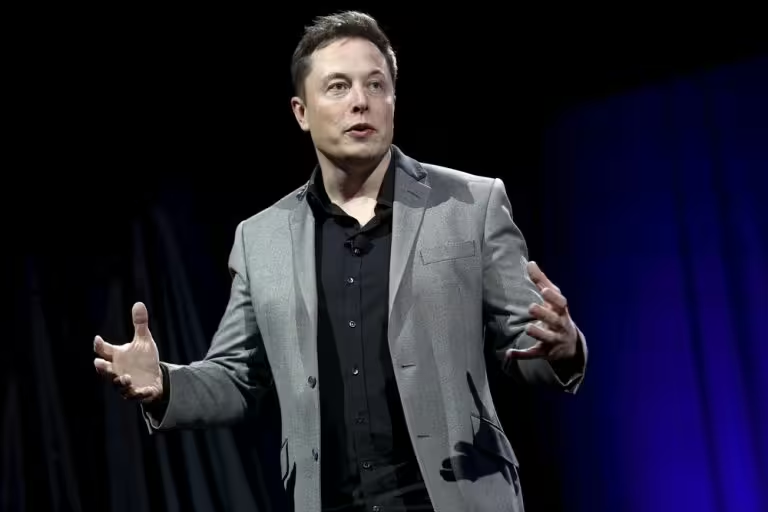
Elon Musk said SpaceX could match the performance of leading artificial intelligence systems such as Fable or GPT-6 within two to three months, then become the industry’s top player in roughly six months if its rate of improvement remains strong. Speaking ahead of high-level AI discussions in Washington, he described himself as “cautiously optimistic” and framed the forecast around the accelerating pace of SpaceX’s capabilities rather than their current level.
Details
- Shorter history: Musk said SpaceX’s AI work is about three years old, compared with roughly six years for Anthropic and a decade for OpenAI. His comparison casts acceleration as the route for closing a gap built through longer research programs and major investment.
- Physical footprint: SpaceX already combines reusable rockets, satellite communications and large-scale engineering. Its Starlink network provides global communications infrastructure that can connect users, machines and increasingly autonomous systems, giving the company a possible basis for competing beyond conventional software products.
- Musk ecosystem: Musk’s wider technology portfolio includes xAI, the developer of Grok. Integrating AI across those businesses could combine models with SpaceX’s computing, communications and engineering assets, with applications spanning mission planning, satellite operations, industrial systems and autonomous technologies.
- Resource race: Frontier models require large amounts of specialized chips, electricity, computing power, training data and data-center capacity. OpenAI, Anthropic, Google and other leading developers are investing heavily in those resources, turning model development into an infrastructure competition as well as an algorithmic one.
- Strategic gathering: Musk is expected at a White House state dinner with President Donald Trump and Chinese President Xi Jinping. Expected or confirmed technology attendees include Jeff Bezos, Michael Dell, Mark Zuckerberg, Jensen Huang, Satya Nadella, Tim Cook, Sam Altman, Greg Brockman and Sundar Pichai; their combined wealth exceeds $2.2 trillion.
- Policy divide: The Trump administration has promoted faster AI development and additional US data centers as part of competition with China. At the same time, Musk and Altman supported warnings from Anthropic CEO Dario Amodei about critical infrastructure, cyberattacks, bioterrorism and economic disruption. The United States still lacks a comprehensive federal AI framework.
Background
Musk has previously given ambitious technology timelines that were not met at the scale or pace he anticipated. During the 2010s, he repeatedly forecast fully autonomous Tesla vehicles without human drivers. In 2011, he predicted humans could reach Mars within a decade, while NASA’s current planning places crewed Mars missions in the 2030s. These precedents distinguish his stated ambition from delivered milestones.
What’s next
Attention now turns to the high-level Washington AI discussions and the expected White House state dinner attended by Trump, Xi and technology leaders. Their positions on data-center expansion, federal oversight and US-China competition will provide the next concrete indicators of how Washington intends to accelerate AI development.