AI data centers turn to converted jet engines as grid waits stretch
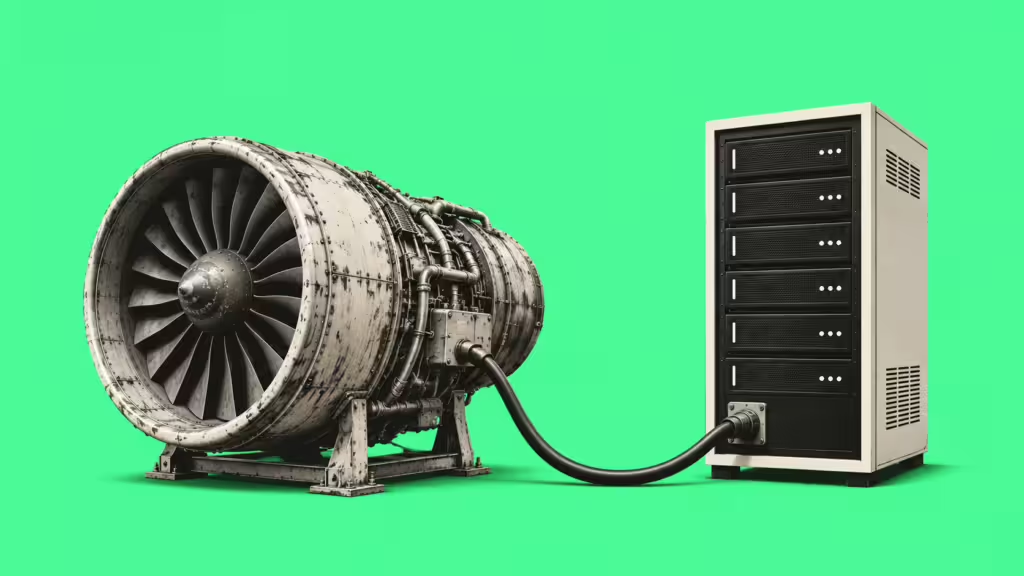
Rebuilt aircraft engines, stripped from retired planes and converted to burn natural gas, are now powering AI data centers whose operators cannot wait years for a grid connection or a new turbine, The New York Times reported Tuesday. Elon Musk’s xAI and OpenAI are among the users.
· Originally published by ontime+ · Source: Bloomberg · Last verified: 4 Nov 2026
Key Points
- AI operators are burning natural gas through rebuilt aircraft engines to skip multi-year grid connection queues
- Hooking 100 megawatts to Northern Virginia's grid takes about seven years, the International Energy Agency says
- The workaround is dirtier and less efficient, suggesting power scarcity now outranks emissions in siting decisions
The latest:
Rebuilt aircraft engines, stripped from retired planes and converted to burn natural gas, are now powering AI data centers whose operators cannot wait years for a grid connection or a new turbine, The New York Times reported Tuesday. Elon Musk’s xAI and OpenAI are among the users. The engines are less efficient and pollute more than purpose-built gas turbines.
Details:
- The speed argument: The appeal is time, not economics. Rystad Energy analyst Audun Martinsen told the Times that with jet-powered units, operators “can have a data center running in 24 months,” compared with roughly seven years to connect 100 megawatts to the grid in Northern Virginia, according to International Energy Agency figures.
- xAI’s build: Musk’s xAI has installed eight converted jet-engine turbines in Mississippi to help power its Colossus 2 data center in Memphis, the Times reported, citing state permits and satellite imagery. The units come from ProEnergy, a company that rebuilds a GE engine commonly fitted to Boeing aircraft.
- OpenAI followed: OpenAI adopted gas turbines in 2025 at its first Stargate site in Abilene, Texas. Denver-based startup Crusoe, which is constructing the Abilene campus, ordered 13 of ProEnergy’s converted units in April, making it one of the larger single buyers of the rebuilt engines.
- A deal abandoned: In September, Crusoe walked away from a $1.25 billion agreement to buy 29 natural gas turbines from Boom Supersonic, a startup developing a supersonic passenger jet that has also begun selling a version of that engine as a data center power plant. A Crusoe spokesperson told TechCrunch the company still plans to use turbines.
- The cost of waiting: Delays are already losing operators business. Microsoft last month pulled out as anchor customer for Nscale’s data center in Loughton, England, after the local utility said it could not deliver sufficient power until the early-to-mid 2030s. The project’s revised customer lineup has not been announced.
- Equipment backlog: The shortage extends to the turbines themselves. An executive at Mitsubishi Power, among the world’s largest makers of power generation equipment, told Bloomberg last week that most new power capacity is expected to come online by 2031 — beyond the horizon most AI buildouts are working to.
- Washington’s push: The Trump administration is adding pressure by encouraging data centers to generate their own electricity, according to the Times, reinforcing a shift away from utility-supplied power toward on-site generation that sits outside conventional grid planning.
- The trade-offs: Converted jet engines are less efficient and pollute more than turbines designed for conventional gas plants, and more units are required to produce the same output, the Times reported. Some experts quoted by the paper expect efficiency and environmental concerns to gain weight within a year or two.
Between the lines:
The economics here are not about cheap power but about time. Operators accepting lower efficiency and higher emissions — and in Crusoe’s case canceling a $1.25 billion turbine order while still committing to turbines — signals that the scarce input in the AI buildout is no longer capital or chips but megawatts available now. Microsoft’s Loughton exit shows the same scarcity reshaping where projects get built.
What’s next
Watch whether Crusoe replaces the Boom Supersonic order with another supplier, whether Nscale secures a new anchor customer in Loughton, and whether regulators move on emissions from on-site generation as installations multiply.