Battlefield Lessons Accelerate Portable Anti-Drone Defenses
The latest Portable counter-drone systems developed by Israeli defense companies are moving closer to infantry-level use as small unmanned aircraft become cheaper, more numerous and increasingly autonomous.
· Originally published by ontime+ · Last verified: 6 Oct 2026 (Caroline Haiat)
Key Points
- Israeli companies are refining portable drone detection and jamming systems through battlefield use and operational testing.
- Mobile tools give infantry warning and intervention where fixed or vehicle-mounted defenses cannot deploy quickly.
- AI-guided drones that navigate after signal disruption are increasing pressure to combine detection with electronic countermeasures.
The latest
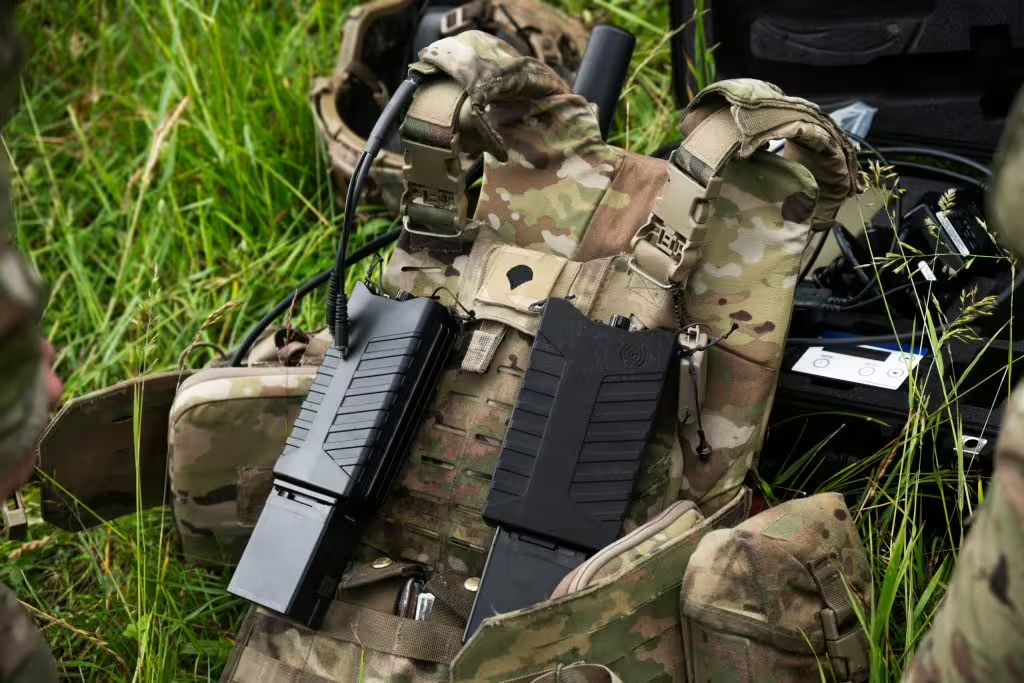
Portable counter-drone systems developed by Israeli defense companies are moving closer to infantry-level use as small unmanned aircraft become cheaper, more numerous and increasingly autonomous. The equipment is used by Ukrainian forces and has undergone operational testing with Israeli forces, reflecting demand for protection that can travel with troops and compress the interval between detecting a hostile drone and disrupting it.
Details
- Early warning: Autonomous Guard’s compact radio-frequency device detects incoming drones at up to two kilometers and issues directional alerts. Its jamming range reaches approximately three kilometers, allowing units to take cover, reposition or intervene before an aircraft enters their immediate field of view.
- Portable interception: SkyLock has developed portable radio-frequency guns intended to neutralize drones without highly precise aiming. Pairing warning with immediate intervention reduces dependence on fixed or vehicle-mounted counter-UAS systems that may be unavailable or too slow to reach infantry.
- Command-level coverage: Sky Spotter Pro, designed for forward battalion command posts and similar tactical elements, detects drones at up to five kilometers, falling to about three kilometers in complex terrain. It can also help locate the operator, supporting faster fire direction and a shorter operational decision cycle.
- Friendly-drone screening: Mission planners can preload information about authorized platforms, helping operators distinguish friendly drones from threats. The capability reduces false alarms and friendly-fire risks as more unmanned aircraft operate simultaneously.
- Operational footprint: Autonomous Guard says its systems have been sold for use in hundreds of U.S. military operations under U.S. European Command and other combatant commands, as well as to Ukrainian forces. In July, European Command tested the technology during a large-scale exercise in Germany involving the 2nd Cavalry Regiment. Interest also extends to police, border units and correctional services.
- Autonomy challenge: Joint Chiefs Chairman General Dan Caine warned in September that U.S. forces should expect to be “hunted by autonomous systems, jammed across the spectrum and tracked in real time.” He also highlighted AI-enabled FPV drones using computer vision to continue toward targets after GPS signals or control links are disrupted.
Background
Ukraine’s use of inexpensive drones for reconnaissance, targeting and attacks has forced militaries to field countermeasures continuously at lower tactical levels. Urban combat presents overlapping surveillance, intelligence-gathering and strike threats under restricted visibility. The distinction between air defense and infantry protection is narrowing as troops increasingly need to detect a small FPV drone, identify whether it is hostile, determine its direction and disrupt it within seconds.
What’s next
The next performance indicator is whether fielded systems can detect and stop AI-enabled FPV drones that keep navigating after jamming severs GPS or operator links, a test of whether detection and electronic disruption can still protect mobile units in combat.