FCC clears SpaceX to launch one million orbital AI data centers
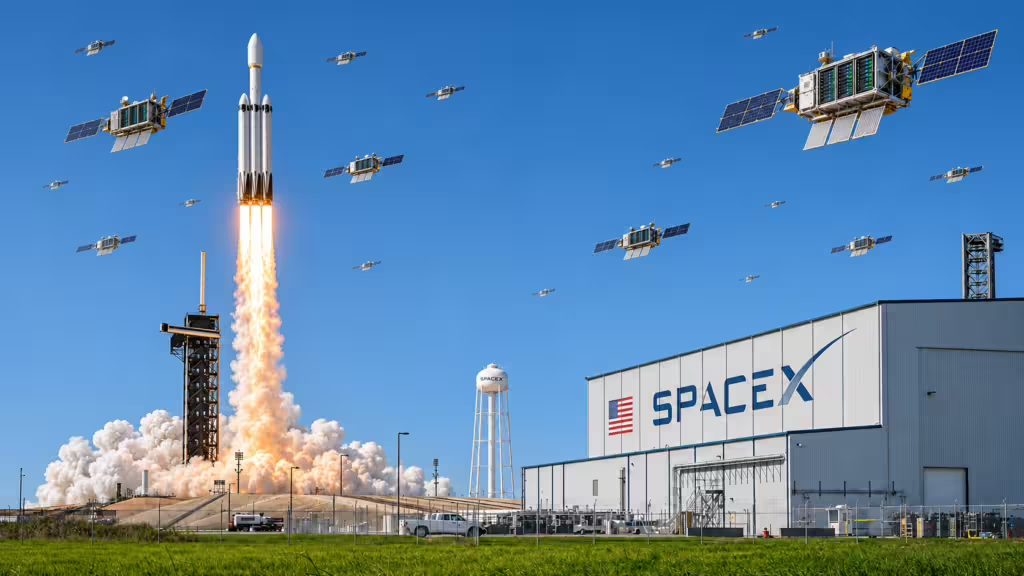
One million artificial-intelligence data-center satellites can now be launched by SpaceX, after the Federal Communications Commission cleared its planned Starmind network.

· Originally published by ontime+ · Last verified: 26 Nov 2026
Key Points
- The FCC approved SpaceX's Starmind network of one million space-based AI data-center satellites, Chair Brendan Carr said.
- Amazon, Viasat and the American Astronomical Society objected, citing missing design details and light pollution.
- Approval backs hardware not yet in operation, and depends on Starship becoming an operational launch vehicle.
The latest:
One million artificial-intelligence data-center satellites can now be launched by SpaceX, after the Federal Communications Commission cleared its planned Starmind network. FCC Chair Brendan Carr announced the decision Wednesday, calling it the kind of American ingenuity that can unite strengths in space and advanced technology and reinforce economic leadership. SpaceX filed the application earlier this year.
Details:
- The timeline: Chief Financial Officer Bret Johnsen said last week that SpaceX plans to launch its first data centers in 2027 and expand through 2029. The FCC authorization is more permissive: it gives SpaceX until 2033 to launch and operate the first satellite, and until 2040 to deploy the full constellation.
- The objections: Amazon, satellite operator Viasat and the American Astronomical Society opposed the application. Amazon argued the plan lacked details on timing and the potential design of the satellites. Astronomers warned a growing number of satellites would increase light pollution and damage the ability to conduct research from Earth.
- The scale: SpaceX is already the largest individual satellite operator, with more than 11,000 Starlink internet satellites in orbit, against 400 for competitor Amazon Leo. The approved Starmind constellation would be roughly 90 times the size of the Starlink fleet currently flying.
- The engineering gap: The systems Starmind requires are not currently in operation. Remaining hurdles include regulating temperatures so AI chips can keep operating in orbit and managing the cost of launching that many satellites. SpaceX also needs its new Starship rocket to be operational before the constellation can fly.
- The business case: Musk has said Starmind could reduce the cost of running data centers because the satellites would be solar-powered. Proponents say moving advanced computing to orbit lets AI developers avoid terrestrial headaches, including efforts to ban data centers.
- The customers: SpaceX’s Earth-based data centers, now part of the SpaceX Super Intelligence group, came with the xAI merger. Hyperscalers including Anthropic and Google have committed to paying billions of dollars in fees to rent capacity from them.
- The balance sheet: SpaceX went public in a June IPO that raised nearly $86 billion. It runs data centers and power plants in the greater Memphis area and recently announced plans to invest another $74 billion in data-center infrastructure near its Starbase, Texas, launch site and in Cochise County, Arizona.
- The chip question: In October SpaceX said it raised $40 billion from lenders to lease Nvidia’s Vera Rubin systems for its terrestrial data centers. The Financial Times reported that lenders sought assurances the chips, which act as collateral for the debt, would remain on Earth.
- The spectrum terms: The decision also authorizes SpaceX to use radio-frequency links for backup and emergency telemetry, tracking and command across the satellite system, and to supplement optical intersatellite links with radio-frequency communications.
- Still pending: The FCC said it is continuing to review additional orbital data-center proposals and intends to issue decisions on each. Orbital data centers have drawn interest from Alphabet’s Google and startups including Starcloud.
Background:
Musk made orbital data centers central to his pitch to investors after merging SpaceX with his AI startup xAI, which runs data centers on Earth.
Between the lines:
The approval runs ahead of the hardware. SpaceX’s own CFO guidance points to a first launch in 2027, but the FCC’s deadlines stretch to 2033 and 2040 — room for a program that still depends on Starship becoming operational and on cooling AI chips in orbit. Lenders already insisting the Nvidia collateral stay on Earth suggests Wall Street is pricing the same uncertainty.
What’s next
Watch for SpaceX’s first orbital data-center launch, targeted for 2027, Starship’s progress toward operational status, and the FCC’s pending decisions on rival orbital data-center applications.