Francis Halzen wins 2026 Nobel Physics Prize for cosmic neutrinos
A cubic kilometer of Antarctic ice turned into the world’s largest particle detector won the 2026 Nobel Prize in Physics.
· Originally published by ontime+ · Last verified: 6 Oct 2026 (Sukaina Khalid)
Key Points
- The Royal Swedish Academy awarded Halzen the 2026 physics prize on Tuesday.
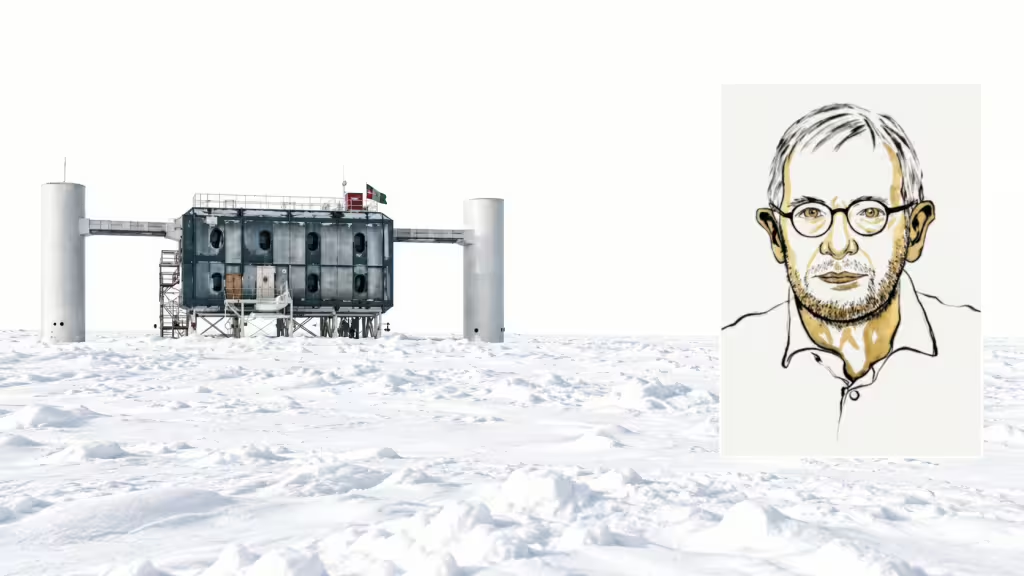
- His IceCube observatory detects high-energy neutrinos using ice at the South Pole.
- The particles carry information from distant galaxies and exploding stars, the Academy said.
The latest:
A cubic kilometer of Antarctic ice turned into the world’s largest particle detector won the 2026 Nobel Prize in Physics. The Royal Swedish Academy of Sciences announced Tuesday it was honoring Francis Halzen for decisive contributions to the IceCube Neutrino Observatory and the discovery of high-energy neutrinos of astrophysical origin. The Academy titled this year’s prize ghostly messengers from space.
Details:
- The laureate: Halzen was born in 1944 in Tienen, Belgium, and is a professor at the University of Wisconsin-Madison in the United States, according to the Academy. The prize citation credits him with recognizing that Antarctic ice could be used to catch neutrino messengers arriving from the cosmos, with other researchers joining the effort afterward.
- How it works: Eva Olsson, secretary of the prize committee, said the award concerns a giant ice cube at the South Pole that traps neutrinos inside the ice. When a neutrino enters, it interacts with the ice and emits light along its path, allowing scientists to reconstruct the particle’s trajectory and identify where in the universe it came from.
- The numbers: Committee member Mark Pearce said more than 1 billion neutrinos pass through a human hand every second, almost all of them from the Sun. The particles behind this research carry roughly 1 billion times more energy and are far rarer: a detector 1 cubic kilometer in size records only about one per day.
- The shift: Olsson said IceCube produced a qualitative leap in neutrino astronomy by detecting ultra-high-energy neutrinos. She added that these particles open a window onto distant galaxies and help scientists understand the processes tied to exploding stars, and that the prize honors Halzen’s idea and vision alongside all the colleagues who worked with him.
- Why neutrinos: Pearce said scientists realized after the neutrino’s discovery that it could serve as a crucial astronomical messenger, because cosmic accelerators deep in the universe can push subatomic particles to enormous energies that cannot be reproduced on Earth.
- The alternatives: Protons from those same sources carry an electric charge, Pearce said, so magnetic fields between Earth and the source bend their paths and make the origin impossible to trace. Gamma rays, high-energy light particles, can interact with dust surrounding the source or with radiation during the journey to Earth.
- The history: Physicist Wolfgang Pauli predicted the existence of a new particle he named the neutrino in 1930. In 1956, Clyde Cowan and Frederick Reines produced the first experimental proof that neutrinos exist, using a nuclear reactor as their source of the particles.
- The calendar: Physics is the second Nobel announced each year, after the medicine prize. The award has been given since 1901, and the Academy presents it as a running record of humanity’s major steps in understanding nature and the universe.
Between the lines:
The choice rewards an instrument as much as a result. Halzen’s contribution, as the Academy framed it, was recognizing that existing Antarctic ice could substitute for a purpose-built detector — a method answer to the problem Pearce described, where charged protons bend and gamma rays scatter before reaching Earth. Neutrinos survive the trip intact, which is why pointing back to a source became possible.
What’s next
Remaining 2026 Nobel categories follow on the Academy’s announcement calendar, with chemistry traditionally next after physics. No date was given for the Stockholm award ceremony.