Iraq Chases Oil Smuggling Empire Tied to Militias and Iran
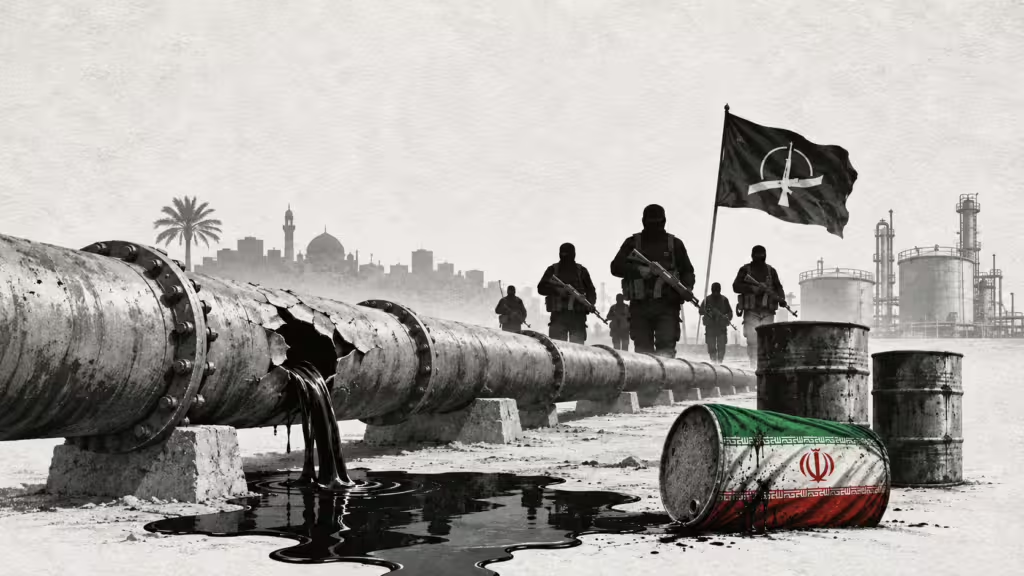
The opening of the Jurf al-Sakhar case and subsequent developments have begun to expose the networks behind Iraq’s oil theft. The systematic plundering of the country’s oil wealth through various channels has long been an open secret among Iraqis.
· Originally published by ontime+ · Source: Reuters · Last verified: 22 Nov 2026
Key Points
- Iraqi courts widen oil-smuggling arrests to Najaf, Dhi Qar and Basra after the Jurf al-Sakhr file opened.
- US investigations link smuggled Iraqi crude to Iran-aligned militias and accuse oil ministry officials of enabling sanctions evasion.
- Al-Zaidi's government faces its hardest test: dismantling the armed factions' economic machine inside state institutions.
The latest:
The opening of the Jurf al-Sakhar case and subsequent developments have begun to expose the networks behind Iraq’s oil theft. The systematic plundering of the country’s oil wealth through various channels has long been an open secret among Iraqis. What remained in question was whether the government — itself part of the problem — would muster the political will to confront it.
That moment came when Iraqi Prime Minister Ali al-Zaidi pledged to take on smuggling networks, regardless of the risks involved. On Sunday, November 22, Iraq’s judiciary announced the detention of a suspect and several energy police personnel in connection with an oil smuggling operation between Dhi Qar and Basra, a day after similar judicial action in Najaf.
The crackdown is part of a broader government campaign targeting networks accused in Iraqi and US reports of exploiting the country’s oil wealth to finance militias and help Iran circumvent sanctions.
Details:
- Jurf al-Sakhr: Iraqi officials speaking to Reuters accused Kataib Hezbollah of running smuggling operations since 2021 with help from security and oil officials, and said the crude taken from the area could be worth hundreds of millions of dollars. The group denied the accusations and tied them to efforts to strip it of its weapons.
- Najaf arrests: The judiciary issued arrest warrants for Mohammed al-Hasnawi, head of the provincial council’s energy committee, and his brother, and detained 8 members of the energy police for questioning. The Iraqi News Agency also reported the arrest of Sheikh Hussein al-Abbasi, an influential Najaf tribal figure, under a smuggling warrant.
- The southern network: The judiciary said it uncovered an organized smuggling ring in Dhi Qar and Basra with divided roles among its members, and detained several police officers assigned to protect the targeted pipeline.
- Kurdistan track: Parliament and a government committee formed by al-Zaidi are investigating intelligence on crude smuggled from Kirkuk and Kurdistan fields via Iran. A Reuters investigation in July 2024 put informal Kurdistan trade to Iran and Turkey at 200,000 barrels per day, worth roughly 200 million dollars a month.
- Ministry corruption: Reuters reported on June 28, 2026 the arrest of Ali Maarij al-Bahadli, oil ministry undersecretary for distribution, in an anti-corruption push that followed statements by refining undersecretary Adnan al-Jumaili after his own detention.
- US sanctions: The Treasury sanctioned al-Bahadli on May 7, 2026, accusing him of using his posts to facilitate oil product transfers benefiting businessman Salim Ahmed Said, the Asaib Ahl al-Haq militia and Iran, including forged origin documents and export privileges for sanctioned firms. The oil ministry denied this, saying export and marketing fell outside his authority.
- The SOMO file: A 2024 US Justice Department indictment over Revolutionary Guard financing described a deal to supply 20 million barrels of Iranian crude, with paperwork pledged under the name of Iraq’s state marketer SOMO. In March 2025, then-oil minister Hayan Abdel Ghani acknowledged seized Iranian tankers carried forged Iraqi documents while denying SOMO wrongdoing.
- SOMO’s position: The company said in February 2026 it had received no official notification of US sanctions and insisted its procedures and documents were sound. Documents bearing a company’s name do not establish institutional involvement in smuggling.
- Militia economics: The Treasury accused economic figures in Asaib Ahl al-Haq of running smuggling operations and using companies and state contracts to serve the faction’s finances, coordinating with Iranian entities linked to the Quds Force across oil, transport and contracting.
- The scale: A Reuters investigation published in December 2024 estimated at least 1 billion dollars a year in revenue from a network smuggling oil products for Iran and its allies.
Between the lines:
The arrests describe a parallel economy where armed factions, state corruption and sanctioned Iranian oil trade overlap. Its danger is financial independence: revenue outside the budget that sustains military and political leverage, which makes cutting the money as consequential as disarmament. The campaign’s real test is whether investigations climb from pipelines to the offices controlling contracts, origin documents and export licenses. Nothing announced so far establishes one network or one beneficiary.
What’s next
Baghdad awaits findings from the government committee on Kirkuk and Kurdistan, plus the court process in Jurf al-Sakhr, Najaf and the south, while the US Treasury keeps expanding sanctions on networks marketing Iranian crude.