Iraq devalues dinar to 1,520 per dollar after oil revenue squeeze
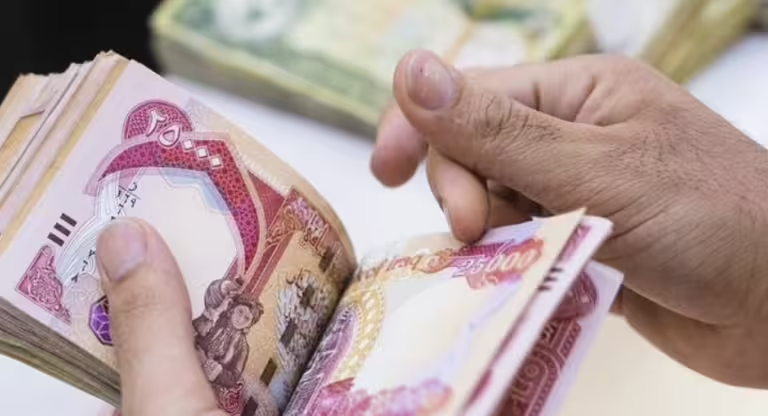
Iraq’s central bank devalued the dinar by about 15%, setting the rate for sales to the public at 1,520 per dollar against 1,320 previously, the Iraqi News Agency reported. The decision landed after months of fiscal strain tied to the Iran war and interrupted oil exports.
· Originally published by ontime+ · Source: Bloomberg · Last verified: 7 Oct 2026
Key Points
- Iraq's central bank cut the official dinar rate to 1,520 per dollar from 1,320.
- The move reverses months of government and central bank denials that any devaluation was planned.
- Oil funds roughly 90% of the budget, and export disruption drained dollar inflows.
The latest:
Iraq’s central bank devalued the dinar by about 15%, setting the rate for sales to the public at 1,520 per dollar against 1,320 previously, the Iraqi News Agency reported. The decision landed after months of fiscal strain tied to the Iran war and interrupted oil exports. Baghdad had publicly ruled out any exchange-rate adjustment as recently as June.
Details:
- The new rate: The central bank set the rate for currency sold to the public at 1,520 dinars per dollar on Wednesday, up from 1,320, according to the Iraqi News Agency. The adjustment amounts to a devaluation of roughly 15% to 16% depending on the reference point used.
- The parallel market: Before the decision, the dollar traded between 1,420 and 1,490 dinars on Iraq’s unofficial market, above the official rate. It is now changing hands between 1,610 and 1,690 dinars, leaving a gap that persists even after the official realignment.
- The reversal: The cut came less than four months after the government and the central bank insisted there was no intention to change the exchange rate. In June, officials also denied plans to print currency or devalue the dinar to offset a liquidity shortage.
- The forged document: That denial followed a forged document circulating at the time which suggested the dollar could be raised to 1,600 dinars. The central bank did not subsequently signal a timetable for the move it has now made.
- The war effect: Pressure on public finances built after the Iran war began and the Strait of Hormuz was closed. Baghdad relies heavily on oil revenue to fund government spending, and the disruption of part of its exports cut dollar inflows into the country.
- The monthly bill: The government needs at least 10 trillion dinars a month to cover salaries and public expenditure, according to previous government statements, while oil accounts for about 90% of budget resources — leaving little cushion when crude shipments are interrupted.
- New governor: The decision came roughly three and a half months after Nizar Nasser Hussein took over as central bank governor on June 21, succeeding Ali Mohsen al-Allaq, as Iraq faced tightened international scrutiny on anti-money-laundering and terrorism-financing files.
- The IMF track: Mazhar Mohammed Saleh, financial adviser to the Council of Ministers, told Asharq Bloomberg in June that Iraq was consulting the International Monetary Fund on the type of assistance it might need if the war’s consequences lasted longer.
- The reserve math: Bloomberg Economics estimated earlier that Iraq needed around $75 billion to maintain the dinar’s fixed peg to the dollar, drawn from foreign reserves of roughly $100 billion on the eve of the war.
- Budget overhaul: Prime Minister Ali Faleh al-Zaidi formed a committee tasked with cutting the budget’s dependence on oil to 45% within ten years from about 90% now, by raising non-oil revenue including border crossings, customs and collection.
Background:
The dinar had been held at 1,320 per dollar, a peg defended with foreign reserves. Successive governments treated the fixed rate as a political commitment, which is why June’s denials were framed as policy rather than forecast.
Between the lines:
The gap between the new official rate of 1,520 and a parallel market trading as high as 1,690 suggests the devaluation has not closed the spread it was meant to address. With oil supplying 90% of budget resources and 10 trillion dinars needed monthly for salaries, the reserve drawdown estimated by Bloomberg Economics points to a peg that had become expensive to defend.
What’s next
Watch whether the parallel market narrows toward 1,520 in coming weeks, any formal Iraqi request to the IMF, the resumption of disrupted oil exports, and the first milestones from the committee on non-oil revenue.