Musk Moves to Merge Tesla and SpaceX in $3.6tn Deal
Tesla and SpaceX have each set up special committees of independent directors to examine folding the two companies into one, Elon Musk said Tuesday, calling the tie-up a good idea while acknowledging he is a conflicted party who cannot join the talks. He warned there is no guarantee terms will be reached.
· Originally published by ontime+ · Last verified: 21 Oct 2026 (Khaled Aziz)
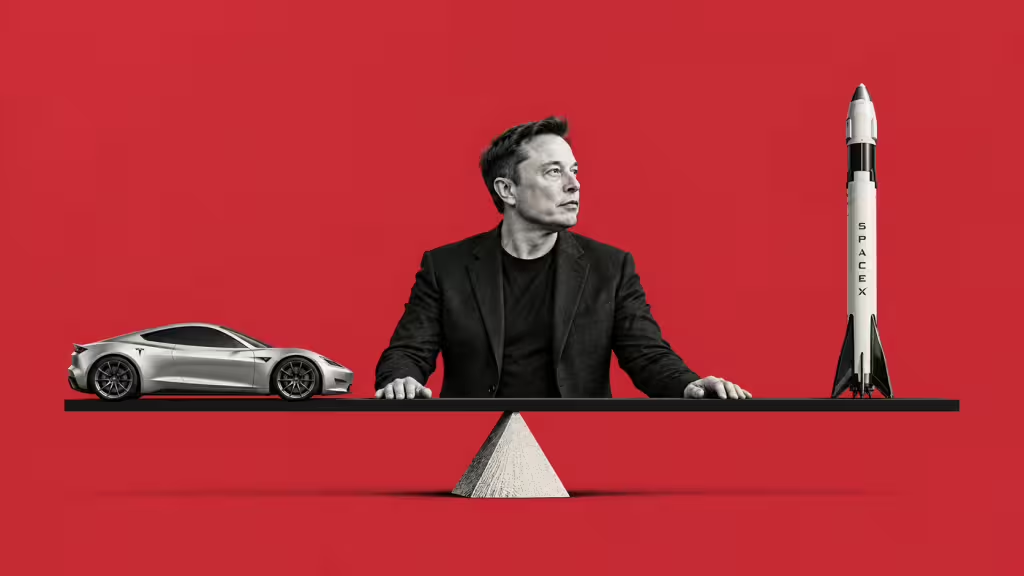
Key Points
- Tesla and SpaceX formed special committees of independent directors to study a merger, Musk said Tuesday.
- The combined company would be worth roughly $3.6tn, ranking among the world's five most valuable firms.
- Regulators in the US, EU, UK and China would scrutinise what would be the largest merger ever.
The latest:
Tesla and SpaceX have each set up special committees of independent directors to examine folding the two companies into one, Elon Musk said Tuesday, calling the tie-up a good idea while acknowledging he is a conflicted party who cannot join the talks. He warned there is no guarantee terms will be reached. SpaceX shares rose 9 per cent in early Wednesday trading; Tesla gained 2.5 per cent.
Details:
- The scale: A combined Musk group would be worth about $3.6tn at current prices, alongside Nvidia, Apple, Alphabet and Microsoft. Analyst forecasts compiled by Visible Alpha put combined revenue at $153bn and headcount above 155,000, spanning rockets, satellites, internet service, chatbots, social media, robots and cars.
- The cash burn: Those same analysts expect negative free cash flow of at least $54bn, driven by Musk’s spending on AI infrastructure, chip fabrication and rockets. Musk said SpaceX would have roughly 3GW of computing power online by year-end and 13GW by the end of next year, with a non-zero chance of exceeding 20GW.
- The AI rationale: Musk framed the merger around artificial intelligence, saying the two companies are pretty much in the superintelligence singularity, the point at which machine intelligence passes human intelligence. He cited gains from co-operating on superintelligent software, chip design, the Terafab plant, robotics and mass to orbit.
- The revenue math: At slightly more than $50 per watt, the price SpaceX says it charges, renting out 20GW would generate about $1tn a year — the top of the $500bn to $1tn run rate Musk projected for end-2027, a scale rivalling Amazon Web Services, Microsoft and Google.
- The existing ties: Musk announced Terafab in March, a Texas semiconductor plant that could cost $119bn and will supply chips for autonomous vehicles, humanoid robots and orbital data centres. SpaceX has bought almost $1bn of Megapack batteries and Cybertrucks from Tesla, including $131mn of trucks last year.
- The voting power: Musk controls roughly 84 per cent of votes at SpaceX through super-voting shares, against about 20 per cent at Tesla, where each share carries one vote. A deal would require backing from a majority of all Tesla shares outstanding, not just those voted, which Musk described as quite a high hurdle.
- The legal shield: Musk has redomiciled both companies to Texas from Delaware. Ann Lipton, a corporate law professor at the University of Colorado, said Texas law lets shareholders sue directors only by showing fraud, intentional misconduct, an ultra vires act or a knowing violation of law — “a much higher bar” than a director standing on both sides.
- The China problem: Tesla generated $21bn in China last year, about 22 per cent of its total, and runs its largest factory in Shanghai. Beijing views SpaceX, a US defence contractor, with suspicion; Chinese military researchers have labelled Starlink a threat since terminals were supplied to Ukraine after Russia’s 2022 invasion.
- The bank’s warning: JPMorgan analysts wrote that Chinese approval could be a particular hurdle given national security sensitivities. They suggested Tesla might ringfence its China business or hand control to a Chinese consortium, a mirror image of the TikTok arrangement, earning licensing fees for its brand and self-driving technology.
- The precedent: A decade ago Musk merged SolarCity into Tesla, drawing a shareholder suit alleging the all-stock deal improperly bailed out one arm of his empire. The judge rejected the claims but criticised Musk’s close ties to Tesla’s independent directors and his involvement in the negotiations.
Background:
SpaceX brings the world’s dominant rocket business and the Starlink satellite network, plus 18 new US national security launch missions signed last quarter and Starshield military satellites. Tesla adds self-driving work and the Optimus robot line, which Musk has predicted could one day make the carmaker worth $25tn.
Between the lines:
The governance questions and the commercial logic point the same way. Moving both companies to Texas narrows the legal route shareholders used after SolarCity, while the voting gap means a merger converts Musk’s 84 per cent control at SpaceX into leverage over a company where he holds about 20 per cent. One top Tesla investor told the FT shareholders cannot tell where Musk is spending his energy or money — a complaint the deal would answer by removing the choice.
What’s next
Watch whether the two special committees agree terms, the Tesla shareholder vote requiring a majority of all outstanding shares, and filings in the EU, UK and China. A person close to Tesla said closing before Donald Trump leaves office is key.