Nobel economics prize goes to rebuilders of Keynesian stabilization theory
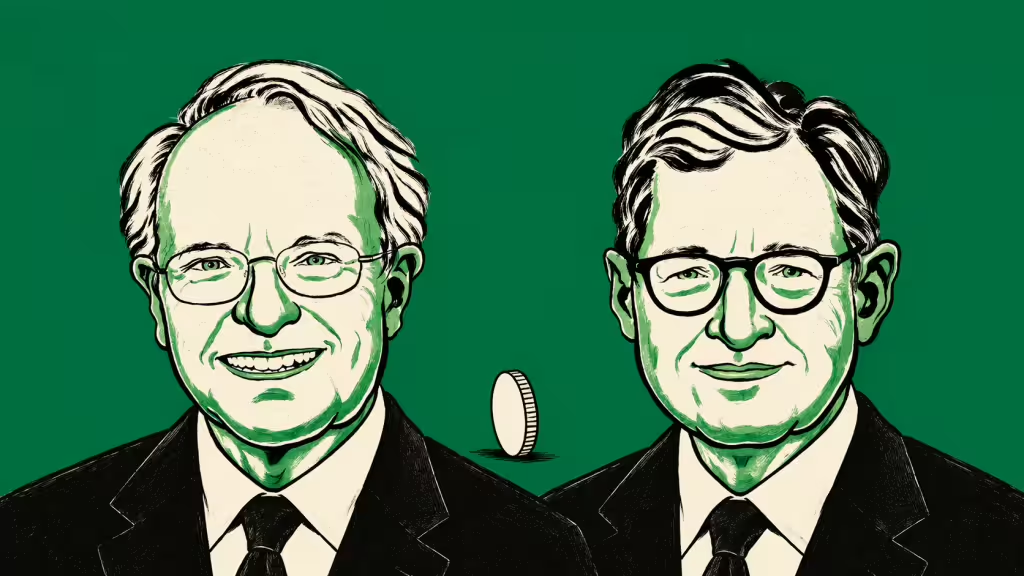
The 2026 Sveriges Riksbank Prize in Economic Sciences in Memory of Alfred Nobel went to two American economists, Robert E. Hall and Michael Woodford, for laying the microfoundations of macroeconomic stability.
· Originally published by ontime+ · Last verified: 12 Oct 2026 (Nada Salam)
Key Points
- Robert E. Hall and Michael Woodford won the 2026 Nobel economics prize, the Royal Swedish Academy announced Monday.
- Both were cited for building microfoundations under macroeconomic stabilization policy after Keynesian models failed in the 1970s.
- The resulting New Keynesian framework is now used by policymakers and central banks worldwide, the Academy said.
The latest:
The 2026 Sveriges Riksbank Prize in Economic Sciences in Memory of Alfred Nobel went to two American economists, Robert E. Hall and Michael Woodford, for laying the microfoundations of macroeconomic stability. The Royal Swedish Academy of Sciences said Monday the award centers on rebuilding the theoretical framework used to analyze business cycles and stabilization policy.
Details:
- The laureates: Hall was born in 1943 in Palo Alto, California, and is a professor at Stanford University. Woodford was born in 1955 in Chicopee, Massachusetts, and is a professor at Columbia University. The Academy said the two reached their contributions separately, not as joint research.
- The citation: The Academy said the prize recognizes contributions to establishing the microfoundations of macroeconomic stability, and described this year’s award as centered on reconstructing a theoretical framework for analyzing business cycles and stabilization policy.
- The problem: Nobel committee chair John Hassler said economies do not always run smoothly: they sometimes slip into recession, unemployment rises, incomes fall, and inflation can spike unexpectedly. Some causes are easy to identify, such as the coronavirus pandemic or an energy price surge, while others are far harder to pin down.
- The policy goal: Hassler said that whatever the cause of the fluctuations, a central objective for governments and central banks is to limit their severity and reduce the risk of the economy sliding into a state where unemployment stays high or policymakers lose control of inflation.
- The Keynesian root: Hassler traced the idea that excessive economic swings occur when markets are left alone to John Maynard Keynes, roughly a century ago. Keynes prescribed stimulating the economy during downturns and restraining it during booms, to hold unemployment down in recessions and inflation low in expansions.
- The 1970s breakdown: Hassler said Keynesian prescriptions appeared to work for a long stretch but failed during the oil crisis of the 1970s, when high unemployment and high inflation arrived together. Many concluded at the time that Keynesian stabilization policy had caused more harm than good.
- The split: According to Hassler, one camp argued policymakers should stop intervening and let business cycles run their natural course. Another held that Keynes’s ideas still mattered but the theory beneath them needed a complete rebuild on sturdier foundations — the gap Hall and Woodford helped fill.
- What microfoundations mean: Hassler said understanding how stabilization policy affects the whole economy requires starting from how households make consumption decisions and how firms set prices. He called that the microfoundations of macroeconomics, the base of the New Keynesian framework now used by policymakers around the world.
Background:
The award is formally the Sveriges Riksbank Prize in Economic Sciences in Memory of Alfred Nobel, funded by Sweden’s central bank rather than the original Nobel endowment, and announced by the Royal Swedish Academy of Sciences.
Between the lines:
The committee’s framing is itself an argument: by tracing the prize back to Keynes and through the 1970s stagflation shock, Hassler positioned Hall and Woodford not as critics of intervention but as the economists who made it defensible again. The Academy said the resulting framework is in active use by policymakers worldwide — a claim about institutional practice, not only academic influence.
What’s next
The Academy has not announced a date for the laureates’ Nobel lectures or the prize ceremony. Watch for the committee’s detailed scientific background document, which typically specifies which papers by each economist were cited.