Nobel Medicine Prize goes to three scientists behind optogenetics
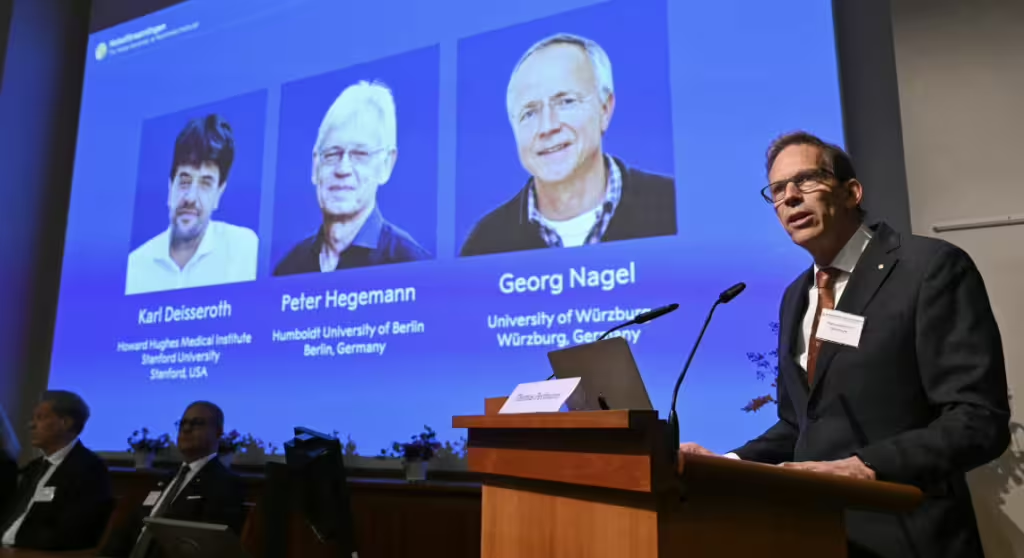
Three scientists who found a way to switch individual brain circuits on and off with light took the 2026 Nobel Prize in Physiology or Medicine on Monday. Karl Deisseroth, Peter Hegemann and Georg Nagel were honored for their discoveries on light-gated ion channels, the proteins that underpin optogenetics.
· Originally published by ontime+ · Last verified: 5 Oct 2026 (Nicole Jeffrey)
Key Points
- Karl Deisseroth, Peter Hegemann and Georg Nagel won the 2026 Nobel Prize in Physiology or Medicine.
- Their work on light-gated ion channels created optogenetics, which switches on specific brain neurons using light.
- The committee said the technique offers clues for treating blindness, depression, addiction and dementia.
The latest:
Three scientists who found a way to switch individual brain circuits on and off with light took the 2026 Nobel Prize in Physiology or Medicine on Monday. Karl Deisseroth, Peter Hegemann and Georg Nagel were honored for their discoveries on light-gated ion channels, the proteins that underpin optogenetics. It is the first of six Nobel Prizes being awarded this year.
Details:
- The science: The three researchers studied light-gated ion channels, a class of proteins that open and close in response to light. Abdel El Manira, a member of the Nobel Committee, said their work established optogenetics, a technique that uses tiny lights to activate discrete groups of neurons inside the brain.
- Why it matters: El Manira said the discovery has illuminated how specific circuits function in the brain. The committee linked it to potential treatment routes for blindness, depression, addiction and dementia, without setting out a timeline for any clinical application.
- The announcement: The prize was announced Monday at the Karolinska Institute in Stockholm, where Thomas Perlmann, secretary general of the Nobel Committee, addressed reporters. The laureates were named together, with no breakdown of how the award is divided among them.
- Last year’s medicine prize: The 2025 award went to Mary E. Brunkow, Fred Ramsdell and Shimon Sakaguchi for discoveries on peripheral immune tolerance, the mechanism that explains how the immune system stops rogue cells from attacking the body’s own tissues and organs.
- The week ahead: The Royal Swedish Academy of Sciences awards the physics prize Tuesday and chemistry Wednesday in Stockholm, the Swedish Academy announces literature Thursday, and the Norwegian Nobel Institute awards the Peace Prize in Oslo on Friday. Economics follows next Monday, with all six announcements streamed live by the Nobel Prize organization.
- Physics precedent: Last year’s physics prize was shared by John Clarke, Michel H. Devoret and John M. Martinis for work that made the behaviors of the subatomic world observable in a system large enough to see with the naked eye.
- Chemistry precedent: The 2025 chemistry prize went to Susumu Kitagawa, Richard Robson and Omar Yaghi for developing molecular building blocks with spaces large enough for gases and other chemicals to flow through them.
- Literature and peace: Laszlo Krasznahorkai, the Hungarian novelist known for dystopian themes and relentless prose, won the 2025 literature prize. Maria Corina Machado took the Peace Prize for building a social movement in Venezuela challenging the country’s authoritarian president.
- Economics precedent: Joel Mokyr, Philippe Aghion and Peter Howitt shared the 2025 economics prize for research explaining the relationship between technological progress and sustained economic growth.
Background:
Optogenetics inserts light-sensitive proteins into chosen neurons, letting researchers trigger them with pulses of light rather than drugs or electrodes. That precision is what allows scientists to isolate the function of a single circuit instead of a whole brain region.
Between the lines:
The committee framed the award around a tool rather than a cure. Optogenetics is valued because it lets researchers test which neurons drive a behavior, and the conditions named by El Manira — blindness, depression, addiction, dementia — are ones where the underlying circuitry remains contested. The prize recognizes a method that makes those questions answerable, not treatments already delivered.
What’s next
The physics prize follows Tuesday in Stockholm, chemistry Wednesday, literature Thursday and the Peace Prize Friday in Oslo, with the economics award next Monday. All announcements are streamed live by the Nobel Prize organization.