Nvidia puts a four-node supercomputing cluster on researchers’ desks
A four-node desktop cluster built around the GB10 Grace Blackwell Superchip went on sale this week, as Nvidia introduced the DGX Spark HPC Developer Kit at the SC26 supercomputing conference in Chicago.

· Originally published by ontime+ · Last verified: 17 Nov 2026
Key Points
- Nvidia launched the DGX Spark HPC Developer Kit at SC26 in Chicago, a four-node desktop cluster.
- Four linked nodes offer 512GB combined memory, 20TB NVMe storage and models up to 700B parameters.
- Nvidia says researchers can skip shared-cluster queues and keep unpublished data on premises.
The latest:
A four-node desktop cluster built around the GB10 Grace Blackwell Superchip went on sale this week, as Nvidia introduced the DGX Spark HPC Developer Kit at the SC26 supercomputing conference in Chicago. The company is pitching it at researchers, academics and developers who currently wait for time on shared GPU clusters. The kit is on display at the conference and already available for purchase.
Details:
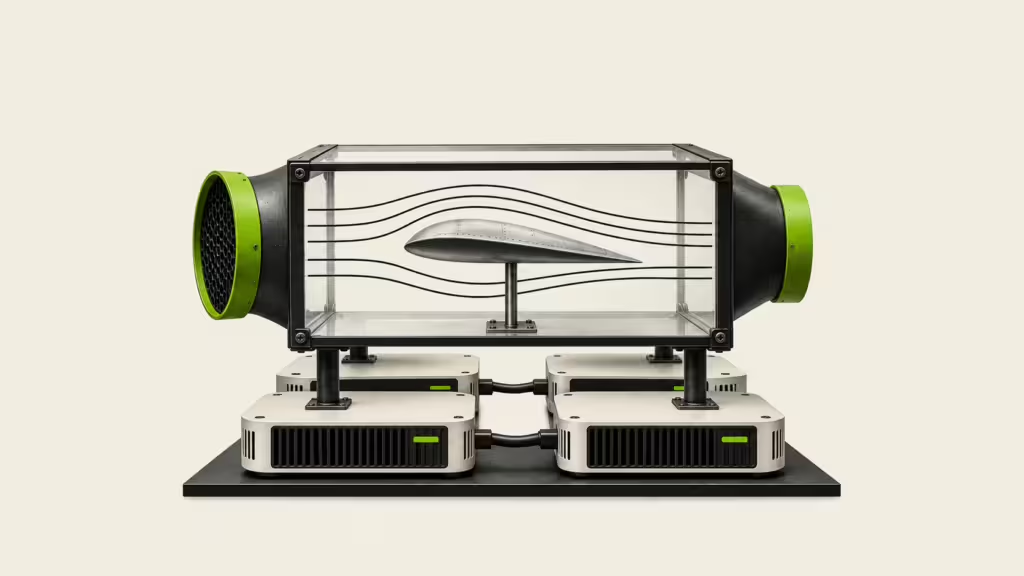
- The hardware: The kit links up to four DGX Spark systems, each connected directly to its two neighbors in a ring over Nvidia ConnectX-7 networking. Nvidia says no network switch is required, and the configuration scales from a single node to four.
- The specs: At four nodes, Nvidia says the cluster delivers 512GB of combined memory and 20TB of NVMe storage. Using NVFP4 quantization, the company says researchers can deploy models of up to 700 billion parameters locally across the four systems, citing DeepSeek V4.1 as an example.
- The pitch: According to Nvidia, teams with fixed compute allocations no longer need to queue for every job, freeing server hours for production runs. The company says unpublished results and proprietary datasets stay on premises rather than moving to shared infrastructure.
- The software: Nvidia says a playbook for its HPC SDK is coming soon, bringing GPU-accelerated C, C++ and Fortran compilers, libraries and message passing interface tools to the cluster. No release date has been announced.
- Validated workloads: Demonstrated four-system workloads include LAMMPS with Kokkos for materials simulation and NAMD for molecular dynamics, according to Nvidia. The company says the wider DGX Spark community has validated GROMACS, OpenFOAM for fluid dynamics, WRF for weather modeling and NIM microservices including OpenFold3 and Boltz-2.
- Quantum chemistry: Kvantify reports running tensor-network simulations of quantum-chemistry circuits with up to 70 qubits and 975 gates on a single DGX Spark, using Nvidia cuQuantum. The company says the benchmark circuits were generated for penicillin ground-state energy calculations.
- The Berkeley results: The Rubin Lab at UC Berkeley’s IGI is using DGX Spark with Nvidia’s Evo 2 model to predict bacterial traits from genome sequences, and reports results arriving 15 times sooner by avoiding 11-hour cluster queue times.
- Chemistry fine-tuning: The Hartwig Group at UC Berkeley says it performed LoRA fine-tuning of the Nemotron 3 Super 120B-A12B model on a single device using NVFP4 quantization, bypassing multi-day queues and running continuous eight- to 24-hour training fits back-to-back.
- Other deployments: CYRAN AI, a spin-out from IIT Delhi, uses DGX Spark and its PixelFlux library to accelerate JPEG 2000 decoding of large satellite images for local geospatial analysis. OpenFold is fine-tuning OpenFold3 on the system to improve protein-ligand structure predictions for drug discovery.
- Where to buy: DGX Spark products and cables are sold through Nvidia Marketplace and OEM partners including Acer, ASUS, Dell Technologies, GIGABYTE, H3C, HP, Lenovo, MSI and xFusion. Nvidia did not disclose pricing for the developer kit.
Between the lines:
The queue is the product here. Nvidia’s own case studies lead with time saved rather than raw performance — 15 times sooner at Berkeley’s Rubin Lab, multi-day waits bypassed at the Hartwig Group — framing the kit as a prototyping tier beneath the data center, not a replacement for it. The on-premises data argument points at the same buyer: labs with proprietary datasets they are reluctant to move.
What’s next
The HPC SDK playbook remains unreleased, and Nvidia has not given a date. Watch whether published pricing and OEM availability follow the SC26 display, and whether more community-validated workloads join the four-node list.