Nvidia’s China AI chip share slides to 34% as Huawei surges
Nvidia’s share of China’s data-centre AI chip market dropped to 34% in the first half of 2026, according to an IDC report seen by Reuters, as Washington’s export controls squeezed what it could legally sell. Its shipments fell 44% from a year earlier to 678,000 accelerators.
· Originally published by ontime+ · Source: Reuters · Last verified: 13 Oct 2026
Key Points
- Nvidia shipped 678,000 AI accelerators in China in the first half, down 44% year-on-year, IDC data showed.
- Huawei shipped 572,000 units, lifting its share to 28% against Nvidia's 34% of the data-centre market.
- The split shows US export curbs and Beijing's substitution push reshaping the world's second-largest chip market.
The latest:
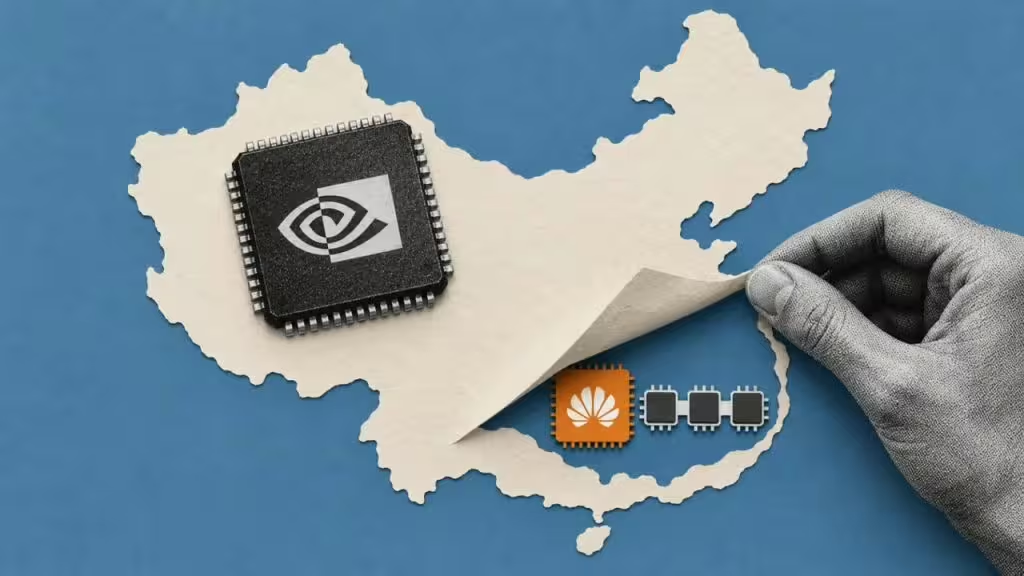
Nvidia’s share of China’s data-centre AI chip market dropped to 34% in the first half of 2026, according to an IDC report seen by Reuters, as Washington’s export controls squeezed what it could legally sell. Its shipments fell 44% from a year earlier to 678,000 accelerators. Huawei, meanwhile, nearly doubled its volumes and now sits six percentage points behind.
Details:
- The numbers: IDC said total AI-accelerator shipments in China reached 2.008 million units in the first half. Nvidia accounted for 678,000 of those, a 44% annual decline, while Huawei shipped 572,000, up from more than 300,000 a year earlier, taking 28% of the overall market.
- The field behind: Alibaba’s chip-design unit T-Head held 7% of shipments, Cambricon 5%, Baidu’s Kunlunxin 4% and Hygon 3%, IDC said. Nine of the 11 Chinese chipmakers the firm tracks increased shipments from a year earlier, a broad-based gain rather than a single-vendor story.
- Washington’s curbs: The United States has restricted China’s access to Nvidia’s most powerful AI chips, narrowing the product range the company can legally offer. Beijing has pushed domestic alternatives in parallel and requires Chinese firms to obtain approval before importing even export-compliant Nvidia parts.
- Nvidia’s position: Chief executive Jensen Huang has repeatedly criticised the export controls, saying the policy forced a US company to hand China’s $50 billion AI chip market to Huawei. Nvidia did not respond to a request for comment on the IDC figures.
- What IDC withheld: The research firm did not specify which Nvidia products made up the 34% share, or whether the figure covered cutting-edge chips such as the B200 and B300. Those models are barred from export to China but have been smuggled into the country.
- The mix shift: Shipments of graphics processing units, the chips most widely used to train AI models, fell 26% to 991,000 units as supplies eligible for sale in mainland China stayed limited. Other AI accelerators rose nearly 80% to 1.016 million, overtaking GPUs by volume for the first time.
- Who buys them: Huawei, T-Head, Kunlunxin and Cambricon together accounted for 95% of the non-GPU segment, IDC said. That category covers chips built for specific AI tasks such as running trained models, and is being adopted by government agencies, internet companies and telecoms providers.
- The next contest: IDC said competition is moving away from the performance of any single chip toward system-level capability, including how well processors operate together inside a larger computing cluster. The firm expects total accelerator shipments in China to grow 19% this year even as GPU shipments fall 9%.
Background:
Washington began tightening controls on advanced AI chip exports to China years ago, repeatedly redrawing the performance thresholds. Nvidia responded with downgraded China-specific products, while Beijing moved to favour domestic suppliers across state and internet sectors.
Between the lines:
The inference-heavy shift is where the Chinese gains concentrate: non-GPU accelerators grew nearly 80% and four domestic firms hold 95% of that segment, while the GPU category Nvidia dominates shrank 26%. IDC’s own forecast of 19% overall growth against a 9% GPU decline points the same way, and its note on system-level competition suggests the contest is widening beyond single-chip performance, where Nvidia’s lead is clearest.
What’s next
Watch IDC’s second-half shipment data against its 19% full-year growth forecast, Huawei’s disclosed accelerator output, and whether Beijing eases or tightens its import-approval requirement for export-compliant Nvidia chips.