Qatar’s Emir: Hormuz Closure Cut Exports, Halved State Revenue
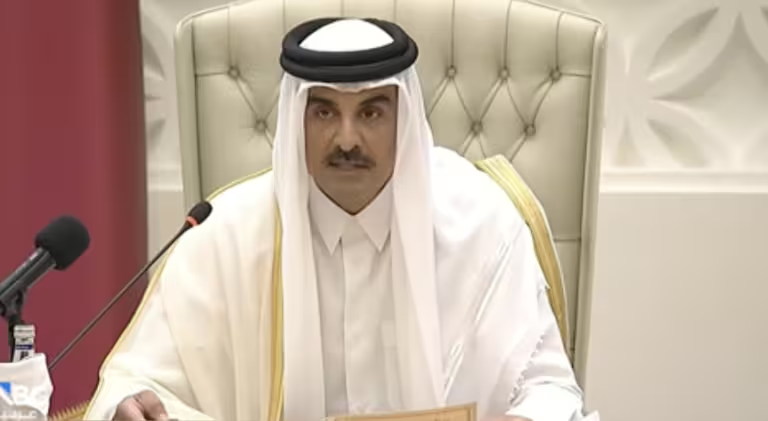
The closure of the Strait of Hormuz and direct damage to energy facilities at Ras Laffan Industrial City disrupted a significant portion of Qatar’s exports, Emir Sheikh Tamim bin Hamad Al Thani said in his address opening the 55th legislative session of the Shura Council.
· Originally published by ontime+ · Last verified: 13 Oct 2026 (Khaled Aziz)
Key Points
- Sheikh Tamim said Hormuz's closure and damage at Ras Laffan disrupted a significant share of Qatari exports.
- Qatar supplies roughly one-fifth of global LNG trade, and state revenue fell 42% in the first half.
- Doha is pressing ahead with North Field expansion and a 221-billion-riyal five-year investment package.
The latest:
The closure of the Strait of Hormuz and direct damage to energy facilities at Ras Laffan Industrial City disrupted a significant portion of Qatar’s exports, Emir Sheikh Tamim bin Hamad Al Thani said in his address opening the 55th legislative session of the Shura Council. He said Qatar supplies about one-fifth of global LNG trade, and anything affecting it feeds quickly through to markets and consumers everywhere.
Details:
- The damage: Sheikh Tamim said the Hormuz closure, combined with direct damage to some energy installations at Ras Laffan, halted an important part of the state’s exports. He said the fallout was concentrated mainly in the energy sector rather than spreading across the wider economy.
- The revenue hit: Total state revenue fell 42% in the first half of the year, the Emir said, while public spending was cut by 14%. He said the reduction was achieved without touching essential services or development priorities, so economic momentum would not slow.
- Non-hydrocarbon growth: Non-hydrocarbon sectors kept growing through the crisis and now account for roughly 80% of real GDP, according to the Emir, who presented the figure as evidence the economy can absorb shocks under exceptional conditions.
- The starting base: Qatar entered the crisis from a strong position, Sheikh Tamim said, citing real growth of 2.9% in 2025, inflation steady at half a percent, a current account surplus, high credit ratings and continued growth in foreign direct investment.
- The fiscal buffer: Pre-crisis policies of building reserves and cutting public debt allowed the state to absorb the impact, the Emir said. He stressed that fiscal discipline and higher spending efficiency would continue as part of the recovery strategy.
- Supply security: The Emir said protecting people and securing their needs was the priority from the first moment of the crisis, with the state working alongside the private sector to diversify supply routes and secure basic goods and strategic stockpiles.
- The investment package: Sheikh Tamim announced projects and investment opportunities worth about 221 billion riyals over the next five years, covering infrastructure and public-private partnerships, and called on the Shura Council to pass legislation strengthening the private sector’s role and the investment climate.
- Energy pipeline: North Field expansion is proceeding on schedule to raise LNG production capacity, the Emir said, noting marked progress on the Golden Pass project in the United States and expanding QatarEnergy investments alongside petrochemicals and solar power projects.
- Food and digital: Qatar ranked first regionally on the 2026 food systems resilience index, the Emir said, with continued support for local agricultural production. He cited more than 360 new digital services and a results-based administrative performance evaluation system.
Background:
The Strait of Hormuz is the sea passage through which Qatari LNG cargoes reach global markets. Ras Laffan Industrial City is the country’s main hub for gas liquefaction and export.
Between the lines:
The Emir framed the episode as a sectoral shock rather than a national one, and the figures he cited carry that argument: an energy-driven 42% revenue drop set against 80% non-hydrocarbon contribution to GDP. His stated goal is not a return to pre-crisis conditions but using the recovery to accelerate diversification — the logic behind both the 221-billion-riyal package and the legislative requests to the Shura Council.
What’s next
Watch for Shura Council action on the investment and private-sector legislation the Emir requested, second-half revenue and spending figures, and progress milestones on the North Field expansion and the Golden Pass project.