Volvo Cars targets mid-2027 for humanoid robots in Ghent production
Volvo Cars is training Hexagon's AEON humanoid robots at its Ghent plant in Belgium.

· Last verified: 27 Nov 2026 (Volvo Cars, Hexagon Robotics)
Summary
- Volvo Cars is training Hexagon's AEON humanoid robots at its Ghent plant in Belgium.
- Training starts with high-precision part placement, then expands to multiple parts and plant navigation.
- The automaker aims to put the robots into actual production from mid-2027.
The latest
Humanoid robots are being trained on real industrial tasks at Volvo Cars' plant in Ghent, Belgium, the first Volvo Cars factory to trial the technology. The carmaker said its own team is training Hexagon Robotics' AEON units through simulation learning, with the stated goal of supporting employees on repetitive work and tasks that are physically demanding. Volvo Cars set mid-2027 as the target for use in actual production.
Details
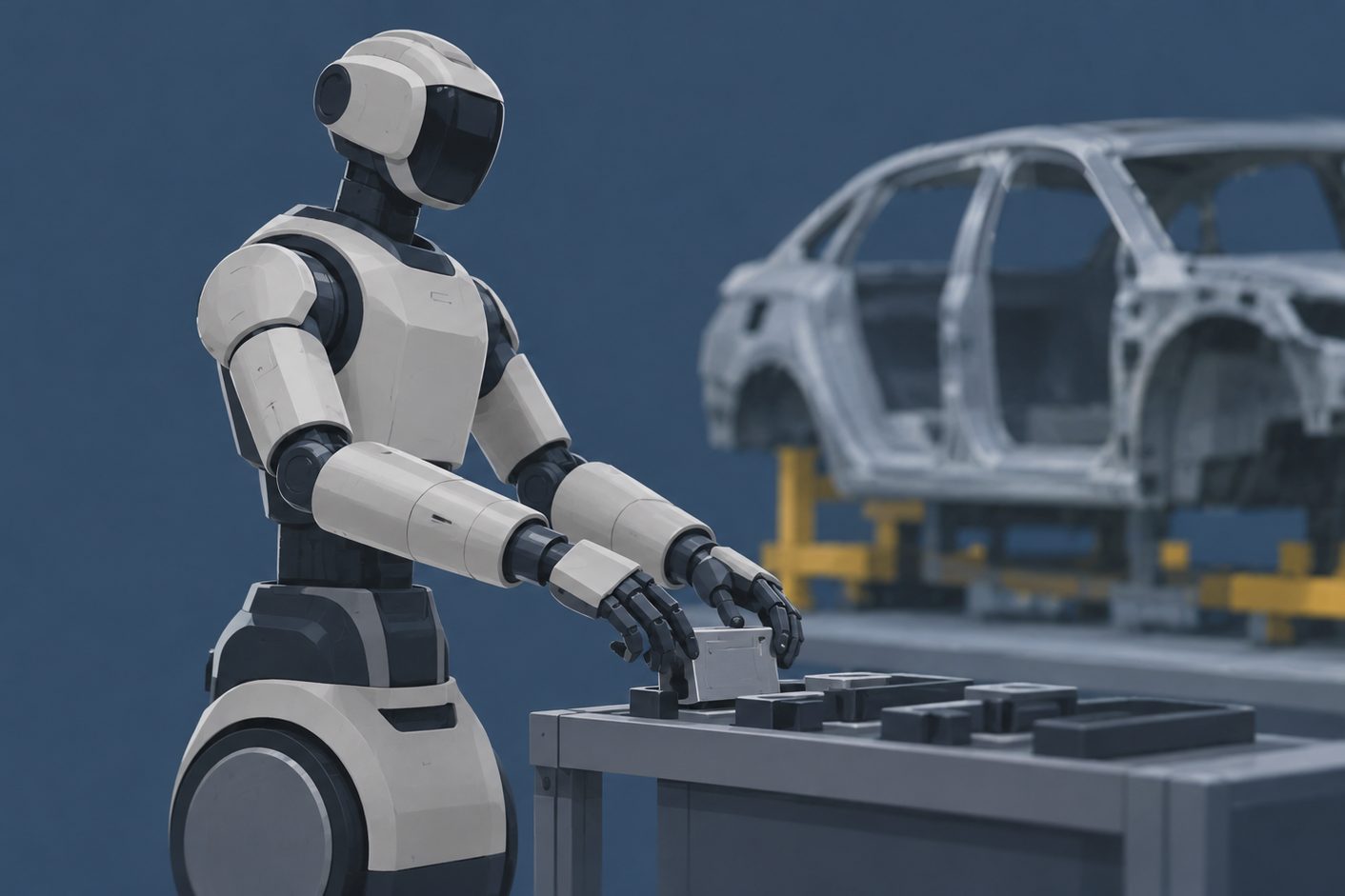
- The first task: Volvo Cars said the robots begin with placing components into two fixtures at high precision. Later tasks add multiple parts, navigation across the production area, and interaction with the plant's existing automated systems, with each stage introduced only as the previous one proves out.
- The training method: According to the company, the robots are trained by Volvo Cars' own team working alongside Hexagon's robotics division, using simulation learning. The company framed the stated purpose as manufacturing that is safer, more flexible and more efficient, rather than a headcount measure.
- The timeline: Volvo Cars said the current training phase prepares for an industrial trial in the first half of 2027, when additional AEON units arrive in Ghent to take on a wider range of tasks. Use in actual production is targeted from mid-2027.
- The machine: Hexagon Robotics' AEON stands 1.65 metres tall and weighs 60 kilograms. It moves on wheels rather than legs, with a top speed of 2.4 metres per second — roughly a light jogging pace — carries 10 kilograms, and uses cameras and sensors. Hexagon describes it as a multi-purpose platform.
- Volvo's framing: Magnus Nilsson, chief manufacturing officer at Volvo Cars, said the aim is for humanoid robots to take on "some of the most physically demanding tasks". He added that AEON's humanoid design means it can fit into production as it stands today, beside existing teams and automation.
- Hexagon's framing: Arnaud Robert, president of Hexagon Robotics, said the purpose of humanoid robotics is to deliver business value to customers. He added that close work with Volvo Cars' teams lets the company ensure AEON performs realistic tasks that support the automaker's manufacturing process.
- The site: Ghent is identified by Volvo Cars as the first of its plants to trial humanoid robots. The company did not say whether the programme would be extended to other factories, and named no additional sites.
- Open points: Volvo Cars did not disclose how many AEON units are currently in Ghent, how many additional units will arrive for the 2027 trial, or the financial terms of the work with Hexagon Robotics.
Between the lines
The sequencing described by both companies is conditional rather than fixed: each added capability — multiple parts, movement through the production area, interaction with existing automation — is introduced only once the previous step holds. Mid-2027 is therefore a target tied to that progression, and the wheeled design and 10-kilogram payload set the practical ceiling on which tasks qualify.
What's next
The industrial trial scheduled for the first half of 2027, when additional AEON units reach Ghent, is the next concrete marker — followed by whether Volvo Cars confirms use in actual production from mid-2027.
Source: Volvo Cars, Hexagon Robotics