Data-center developers turn to the ocean to escape local opposition
Startups are proposing floating and seabed data centers powered by waves, tides and solar energy.
· Last verified: 15 Nov 2026 (The Wall Street Journal)
Summary
- Startups are proposing floating and seabed data centers powered by waves, tides and solar energy.
- Land-based data centers face mounting public opposition over power and water consumption.
- Corrosion, storms and whale habitat concerns leave the offshore model commercially unproven.
The latest
A growing group of startups wants to move artificial-intelligence computing offshore, betting that facilities floating at sea or sitting on the seabed will draw less public resistance than data centers built in neighborhoods. Most projects aim to generate their own electricity from waves, tides, wind or solar panels and to cool servers with surrounding seawater, addressing two of the loudest objections raised on land.
Details
- The funding: Portland-based Panthalassa raised $140 million in May to build steel structures 278 feet long that would power AI computing with wave-generated electricity while floating untethered in the Pacific. Investors include Peter Thiel. The company says it plans to test its next-generation data center later this year and begin commercial deployment in 2027.
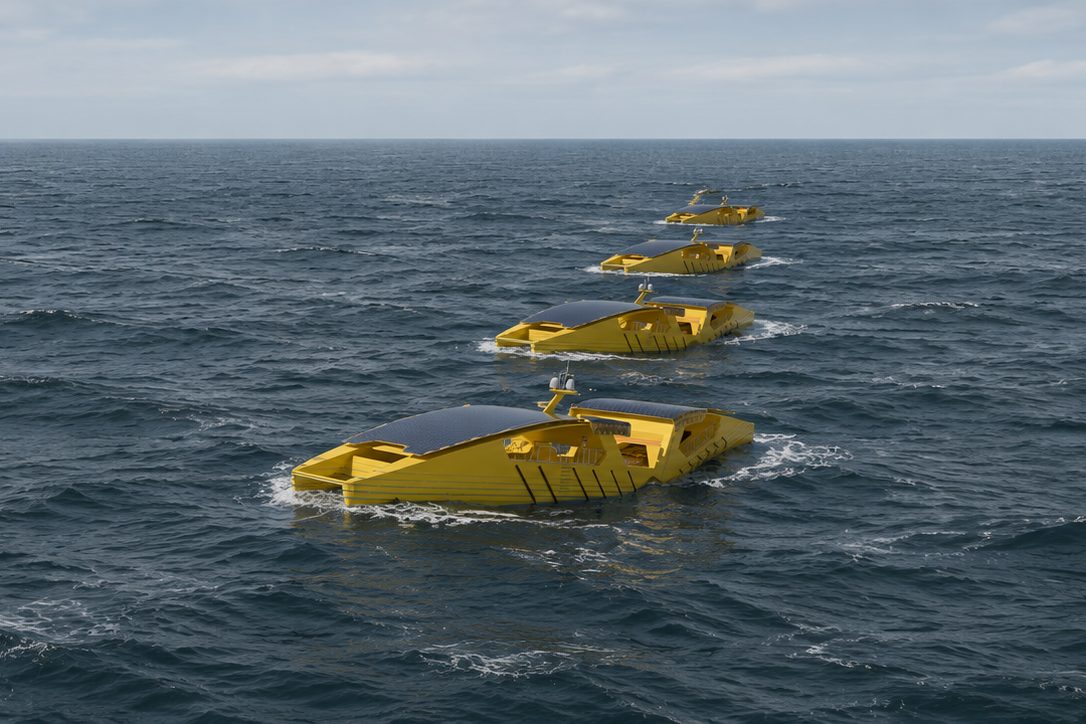
- The Scottish bid: Mocean Energy announced in July it would place AI servers on floats far out at sea, powered by waves and solar panels, cooled by surrounding water and linked to shore by satellite. The firm completed a 13-month test of its wave-energy system in spring 2024 and is now seeking funds for a demonstration.
- The numbers: Mocean intends each node to deliver about 500 kilowatts, though the test unit produced roughly 10 kilowatts. Co-founder and chief executive Cameron McNatt says nodes could be grouped to supply up to 100 megawatts, targeting a gigawatt of capacity within five years and 10 gigawatts within a decade.
- The partnership: Ocean Power Technologies of New Jersey and Stratum Holdings of Florida signed a nonbinding letter of intent in October to test whether Ocean Power's prototype buoys, powered mainly by waves, wind and solar, could run Stratum's AI infrastructure without a power cable to shore.
- The seabed route: Massachusetts-based DeepGreen Holdings has applied for a federal permit to study a tidal-powered underwater data center off Eastport, Maine, and filed a similar application for Alaska's Cook Inlet. Managing member Louis Wolfson says the company is still vetting turbine and equipment partners and has put nothing in the water.
- The shipping option: Japan's Mitsui O.S.K. Lines says it wants to build a new vessel or convert an existing ship into a floating data center moored in a port, powered either from shore or by a separate power ship. Shinichi Ogawa, who leads the effort, says the company is still weighing sites.
- The engineering problem: Bryson Robertson, director of the Institute for Integrated Energy Systems at the University of Victoria, says subsea cables to shore could exhaust a project's budget before the concept is proven. Drifting machines avoid mooring costs but can be dragged off location by storms, and steering them back consumes power meant for computing.
- The corrosion risk: Climate-technology consultant Michael Barnard says salt attacks metal immediately and that barnacles, minerals and microorganisms clog intake filters and coat the heat exchangers cooling the servers. Mocean says it plans to use marine-grade anti-corrosion and antifouling paint, and to tow units back to dock for scheduled repairs.
- The environmental fight: Groups opposing DeepGreen's Maine plan say the Bay of Fundy hosts some of the world's most endangered whales. Kristen Monsell of the Center for Biological Diversity, which has filed to join the federal review, says moving further offshore adds boat traffic, strike risk, noise, pollution and heat.
- The response: Wolfson says the multiyear preliminary study exists to examine exactly those concerns, and that DeepGreen is reviewing only turbine systems operating within safe acoustic limits for marine mammals and fish. He says the company plans to consult tribal leaders, fishermen and town officials before seeking a license.
Background
Wave-energy projects are not new. Companies in the sector have failed at a high rate over the years, driven by the harsh ocean environment and high costs. Mocean's prototype grew out of a decade of work supplying electricity to offshore oil-and-gas operators.
Between the lines
Robertson argues wave devices cannot simply be scaled up, because each must be tuned to local wave rhythms, comparing an oversized unit to a wind turbine too large for available wind. That constraint, combined with the gap between Mocean's 10-kilowatt test output and its 500-kilowatt target per node, suggests the gigawatt ambitions depend on multiplying units rather than enlarging them. Robertson still sees value in well-funded technology companies underwriting further attempts.
What's next
Watch Panthalassa's next-generation test, scheduled for later this year, ahead of planned commercial deployment in 2027. The federal review of DeepGreen's Eastport permit application, which the Center for Biological Diversity has moved to join, is the other near-term decision point.
Source: The Wall Street Journal