$4.2 Trillion — Lost by Data Centers Since Last June
Manufacturing, utility and mining firms linked to data centre construction lost $4.2tn in value since June.
· Last verified: 15 Nov 2026 (FactSet)
Summary
- Manufacturing, utility and mining firms linked to data centre construction lost $4.2tn in value since June.
- The drop erases nearly half of $9.4tn those same companies gained in the prior 12 months.
- The sell-off shows investor confidence in the AI buildout now extends beyond chipmakers to industrial suppliers.
The latest
Global manufacturing, utility and mining companies tied to data centre construction have shed $4.2tn in market value since June, according to an analysis by the Financial Times. The companies most frequently linked in media coverage to data centre projects were hit hardest, as the AI picks-and-shovels trade — the bet on suppliers rather than on model developers themselves — swung into reverse.
Details
- The scale: The $4.2tn decline since June wipes out close to half of the $9.4tn in value the same group of companies added over the preceding 12 months, according to the FT analysis. The gains had come as investors bought into manufacturers across the supply chain feeding hyperscale data centre construction.
- Caterpillar: The heavy equipment maker, a leading supplier of gas generators to data centres, has lost $214bn in market capitalisation since its shares reached an all-time high on June 30, a 44 per cent decline, according to FactSet data cited by the FT.
- Nuclear power: Oklo fell 49 per cent over the same period, despite having signed a contract with Meta in January. The company's agreement with one of the largest data centre operators did not insulate it from the broader repricing of AI-linked industrial names.
- Other losers: Comfort Systems, a maker of HVAC systems used to cool server halls, and Corning, which manufactures the advanced fibre optics needed to connect AI server racks, each lost around half of their value since June, according to the FT.
- What was bought: Investors had piled into makers of everything from jet engines adapted to power hyperscale data centres to specialised fibre optics, treating the physical inputs of the AI buildout as a growth story in their own right rather than as cyclical industrial demand.
- The diagnosis: Paul Kedrosky, a venture capitalist and fellow at the MIT Institute, said investors had been wrong to start treating old-school industrial firms like semiconductor stocks. He described the idea that everything had become a growth stock as "ludicrous, of course."
- The mechanism: The FT analysis found the correlation ran through media association: the more frequently a company was linked in coverage to data centre construction, the harder it was hit in the sell-off — a pattern consistent with narrative-driven rather than earnings-driven repricing.
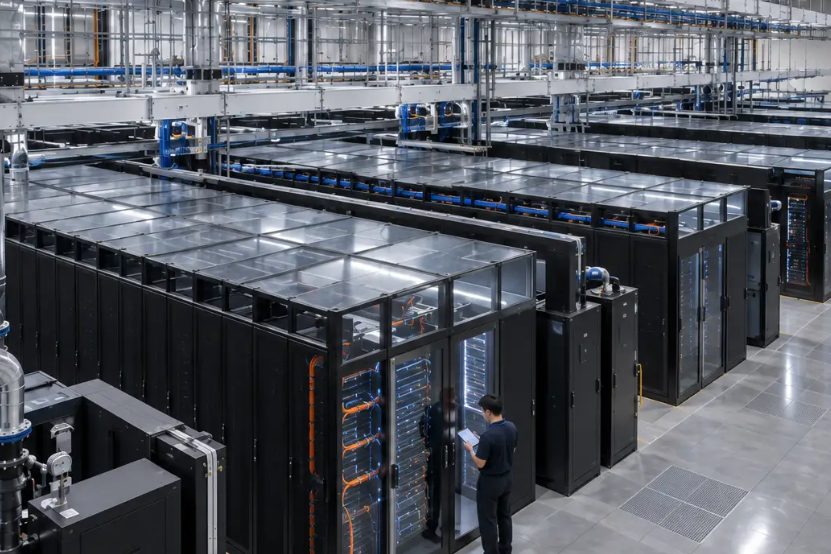
- The backdrop: Meta's Eagle Mountain data centre in Utah was still under expansion in January 2026, an indication that physical construction activity continued even as the equity market repriced the companies supplying it.
Background
The picks-and-shovels trade borrows from gold rush logic: rather than betting on which AI model wins, investors buy the firms selling the equipment every builder needs — generators, cooling systems, fibre, turbines. That bet turned industrial manufacturers into high-multiple growth names.
Between the lines
The gap between falling share prices and continuing construction is the core tension. Caterpillar, Oklo and Comfort Systems all sell into projects that are still being built, yet lost between 44 and 49 per cent of their value. That points to a repricing of expected multiples rather than cancelled orders — consistent with Kedrosky's argument that industrial firms were wrongly valued like semiconductor stocks.
What's next
Watch upcoming earnings from Caterpillar, Corning and Comfort Systems for whether data centre order books match the share price declines, and whether hyperscaler capital expenditure guidance confirms or contradicts the market's repricing.
Source: FactSet