OpenAI launches drug-chemistry benchmark; top model scores 84.5%
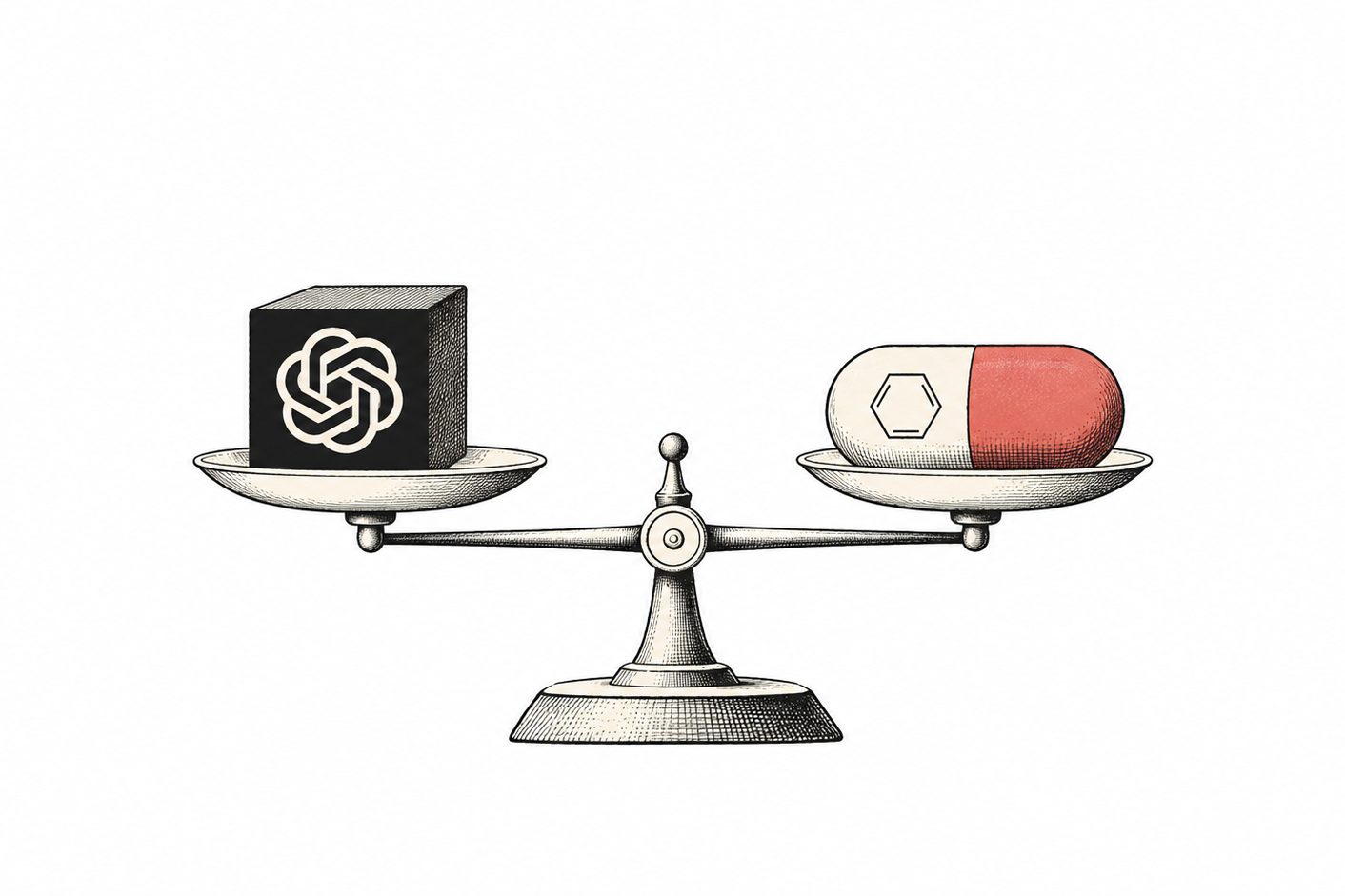
OpenAI released MedChemBench, 99 problems testing whether AI models can reason like medicinal chemists.

· Last verified: 21 Nov 2026 (OpenAI)
Summary
- OpenAI released MedChemBench, 99 problems testing whether AI models can reason like medicinal chemists.
- GPT-6.2 Astra earned 84.5% of available credit at the xhigh reasoning setting, OpenAI said.
- Models read molecular structures well but struggled to pick compounds and predict numbers.
The latest
A new OpenAI benchmark grades AI models on the judgment calls medicinal chemists make daily: reading a molecule's structure, interpreting lab results, and deciding which compound to test next. Called MedChemBench, it runs 99 problems drawn from published research. OpenAI said GPT-6.2 Astra earned 84.5% of available credit at its xhigh reasoning setting, ahead of GPT-6 Astra at 83.3%.
Details
- The scores: At the xhigh setting, OpenAI reported GPT-6.2 Astra at 84.5% of available credit, GPT-6 Astra at 83.3%, GPT-6.1 Sol at 82.0%, GPT-6.1 Terra at 75.1%, and GPT-5.6 Sol at 58.2%. At maximum effort, GPT-6 Astra reached 83.8%.
- The test set: MedChemBench draws on 117 papers and patents and includes 761 distinct molecular structures, according to OpenAI. Most problems give the model the context a researcher would have at a chosen point in a program: the biological target, stated goals, compounds studied so far, and selected experimental findings.
- Four graded components: OpenAI said the benchmark scores molecular structures, including atom connections and stereochemistry; scientific reasoning supported by supplied evidence; ranking and selection of compounds against stated requirements; and property predictions measured against values and categories reported in the source research.
- The weak spot: Astra earned 95.4% of available structure credit at xhigh but only about half the credit for selecting compounds and predicting numerical properties, OpenAI said. Reconstructing molecules and explaining evidence proved far easier for the model than deciding what to make next.
- The core problem: OpenAI framed the underlying difficulty as a tradeoff: improving one property of a molecule often degrades another. A compound may bind strongly to a disease-related protein yet absorb poorly or break down too quickly in the body, forcing chemists to design and test related compounds iteratively.
- A worked example: One problem uses inhibitors of PRMT5, a protein studied in cancer drug discovery. The model must predict how three related compounds block PRMT5 in cells, cross a cell barrier, and resist liver enzymes. Withheld results showed compound 23 blocked PRMT5 at a lower concentration, while compound 24 crossed more readily and degraded more slowly.
- Spatial reasoning gap: Another task asks models to assemble a molecule while preserving an 18-atom ring. At xhigh, GPT-6 Astra reconstructed it correctly in all ten responses; GPT-5.6 Sol and GPT-5.6 Luna failed all ten. In the illustrated answers, Sol produced a 15-atom ring and Luna split the molecule into two disconnected fragments.
- The scale of testing: Eleven GPT models were evaluated at different reasoning-effort settings, OpenAI said, with xhigh the highest setting shared by all eleven. Higher settings improved scores across the board while large gaps between models persisted, and partial credit was awarded on predictions based on closeness to measured values.
- The caveats: OpenAI stated the results do not establish whether models can discover new drugs or improve laboratory decisions. Prior exposure to the published sources cannot be ruled out, and each response was a single attempt without tools, feedback, or new experiments.
Background
Medicinal chemistry advances by iteration: chemists design a compound, test it, read the data, and decide what to synthesize next. Benchmarks until now have largely graded factual recall or isolated property prediction rather than that sequential decision-making under competing constraints.
Between the lines
The gap between 95.4% on structures and roughly half the credit on selection and prediction marks where the commercial value sits. Reconstructing a molecule is pattern work; choosing which of three compounds to advance is the decision pharmaceutical programs actually pay for. OpenAI's own caveat on possible prior exposure to published sources also limits how far these scores can be read as evidence of novel reasoning.
What's next
Watch whether OpenAI opens MedChemBench to outside model developers for comparative scoring, and whether any pharmaceutical group reports testing the benchmark's selection tasks against live discovery programs rather than historical published results.
Source: OpenAI