Mercedes puts AI inside the car, cutting the cloud out
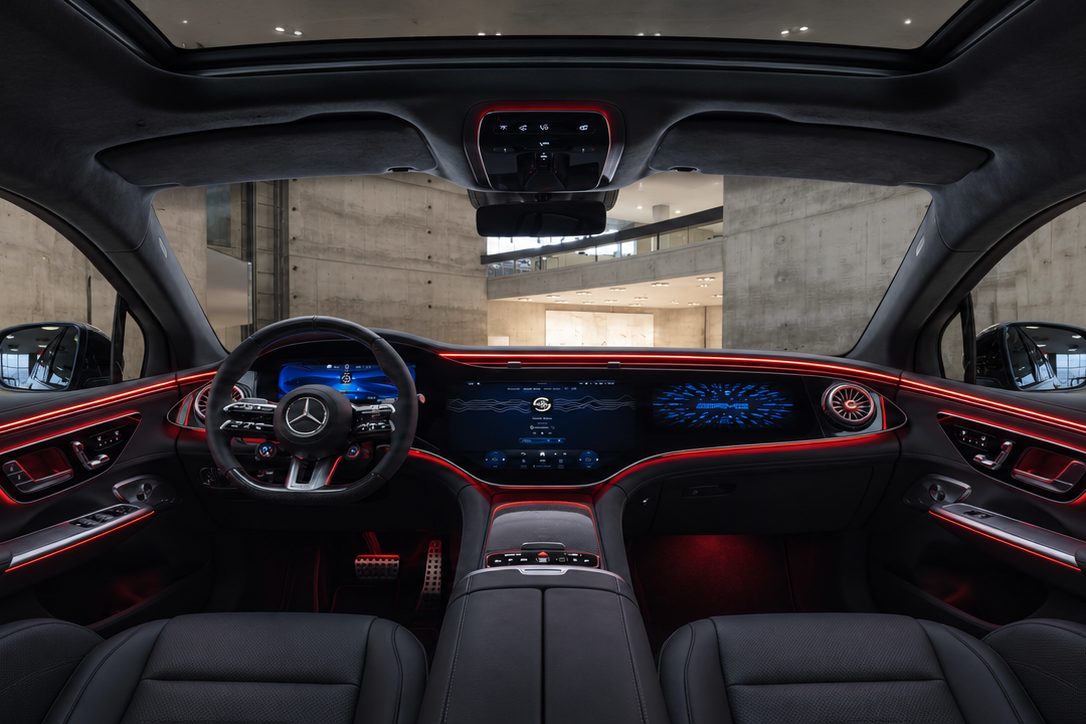
Mercedes-Benz is running conversational AI models directly on cars using MIT spinout Liquid AI.
· Last verified: 5 Nov 2026 (The Wall Street Journal)
Summary
- Mercedes-Benz is running conversational AI models directly on cars using MIT spinout Liquid AI.
- Rollout began in North America in October via over-the-air updates, at no extra cost.
- On-device processing promises lower latency, offline function and data that stays in the vehicle.
The latest
Mercedes-Benz has begun shipping conversational AI that runs on the car itself rather than in the cloud, using foundation models from Liquid AI, a startup spun out of MIT. The rollout started in North America in October through over-the-air updates, according to The Wall Street Journal. Mercedes signed the agreement with Liquid AI in April.
Details
- The models: Liquid AI, founded in 2023 and based in Cambridge, Massachusetts, with offices in San Francisco and Tokyo, builds models designed to run directly on a device instead of a data center. The company says that approach delivers more privacy and lower latency.
- What it controls: Jason Hoff, chief executive of Mercedes-Benz North America, said the system handles features like heating and infotainment rather than driving itself. He described free-flowing conversational interaction as a priority for customers, and said autonomous driving remains a separate effort with different partners.
- The handoff: Hoff said the most common commands include navigation, seat settings including the massager, music control and phone calls. Questions beyond the on-device models' scope, such as local restaurant recommendations, fall back to larger cloud models to answer.
- The advantages claimed: Hoff cited privacy, speed, better handling of accents, and the ability to work without constant connectivity. Mercedes said the system is more secure because there is less traffic between the cloud and the vehicle, and that it designs for privacy from the outset.
- The schedule: Deployment started with 2027 models including the E-Class and CLE, plus select older vehicles depending on system generation. A broader rollout covering the 2027 S-Class, GLC Electric and GLE is planned for the second quarter of 2027. No subscription or additional payment is required.
- The business pressure: Mercedes cut its expectations for the year last month, warning of a worsening market in China and higher fourth-quarter costs including raw materials. Chief Executive Ola Källenius told the October earnings call the company is focused on building a faster, more competitive Mercedes-Benz as AI changes how it works.
- The funding: Liquid AI raised a $250 million Series A in December 2024, led by chip designer Advanced Micro Devices. Its MIT-researcher founders developed an architecture called liquid neural networks, adaptive systems inspired by the neural activity of the worm C. elegans.
- The market forecast: Gartner projects on-device models will handle 30% of all user-initiated AI tasks in enterprise applications by 2029, up from near zero in 2026. The firm counts 1.6 billion AI-capable edge devices shipped from 2024 through 2026, with shipments growing at a 20.4% compound annual rate from 2025 to 2030.
- The caveat: Craig Roth, research vice president at Gartner, said most enterprise applications still default to cloud models, and that cost and privacy benefits have not been enough to push companies into custom on-device builds. He assessed that this could change at some point.
Background
Mercedes-Benz's U.S. division has offered a version of cloud-based conversational AI in its cars since 2023. The Liquid AI partnership replaces that approach for core in-cabin commands with processing that happens inside the vehicle.
Between the lines
The timing links two separate pressures. Mercedes is deploying the feature at no extra charge while trimming its full-year outlook on China weakness and rising costs, suggesting the assistant is positioned as a sales differentiator rather than a revenue line. Roth's assessment that enterprises have not adopted on-device models makes vehicles an unusual early proof point, since cars cannot rely on steady connectivity and some functions need responses faster than a data-center round trip.
What's next
The second quarter of 2027 is the marker to watch, when Mercedes plans to extend the system to the 2027 S-Class, GLC Electric and GLE. Mercedes' fourth-quarter results will show whether the China slowdown deepened.
Source: The Wall Street Journal