Riyadh Airport Shutdown Clouds Saudi Investment Summit Two Weeks Out
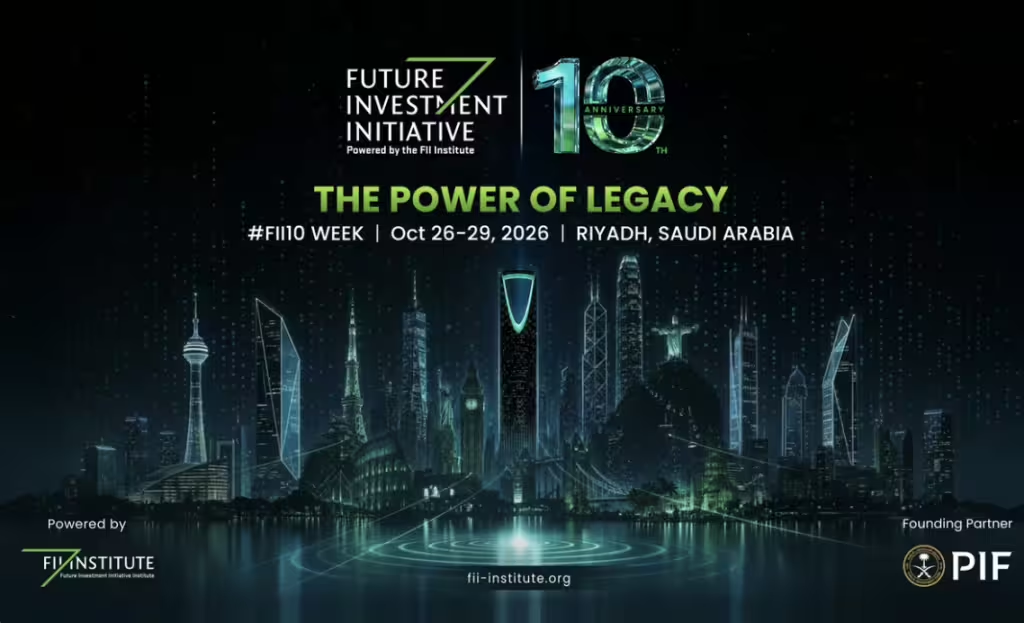
Riyadh’s main airport is shut following deadly Houthi attacks, leaving bankers and executives scrambling to reassess travel to the Future Investment Initiative, which opens October 26.
· Originally published by ontime+ · Source: Bloomberg · Last verified: 14 Oct 2026
Key Points
- Houthi strikes closed Riyadh's main airport, upending travel plans before the Future Investment Initiative opens October 26.
- Organizers are weighing contingency options including virtual panels, people familiar with the matter told Bloomberg.
- The disruption tests the kingdom's pitch to global capital as mega-projects are reworked and private financing grows central.
The latest:
Riyadh’s main airport is shut following deadly Houthi attacks, leaving bankers and executives scrambling to reassess travel to the Future Investment Initiative, which opens October 26. Organizers are sizing up contingency measures should conditions materially deteriorate, people familiar with the matter told Bloomberg, including allowing some executives to join panels virtually as they did during the pandemic.
Details:
- The trigger: Strikes by Yemen’s Houthis have closed the capital’s main airport, the gateway used by tourists and financial executives alike, according to Bloomberg. The group has fired missiles and drones at Saudi cities, with control-area data drawn from the Institute for the Study of War and AEI’s Critical Threats Project.
- The contingency: Organizers are evaluating how to hold the conference if conditions worsen, people familiar with the matter said, with virtual attendance one option. FII pointed Bloomberg to a Sunday statement saying it is preparing to “welcome thousands of delegates to Riyadh” from October 26.
- The hesitation: Travel warnings from the United States and United Kingdom have prompted some invitees to reconsider, Bloomberg reported. Executives who declined to be identified said firms are reluctant to be first to pull out, with some awaiting official guidance and others deciding closer to the date.
- The stakes: The Riyadh conference drew agreements worth more than $50 billion in 2025, according to Bloomberg. Public Investment Fund Governor Yasir Al-Rumayyan has said it enabled over $250 billion in cumulative deals since inception, though the final value is harder to pin down because many announcements are memoranda of understanding.
- The lineup: Organizers unveiled high-profile attendees including Goldman Sachs chief David Solomon and BlackRock’s Larry Fink, which Bloomberg read as a signal of determination to keep the economic agenda on track. Fink is among the few senior Wall Street figures to have publicly visited the kingdom recently.
- The official line: Energy Minister Prince Abdulaziz bin Salman said at an event this week that no one would break the kingdom, comparing it to a phoenix repeatedly rising from the ashes. H.A. Hellyer of the Royal United Services Institute assessed that the entire Saudi vision is being held hostage by the Houthis.
- The capital shift: Wall Street executives were privately questioning Riyadh’s ability to deploy cash even before the Iran war began, Bloomberg reported. Global SWF said in a recent report that PIF has slowed the volume of investments outside the kingdom while placing high-conviction bets and concentrating its overseas portfolio.
- The rivals: After a tenuous ceasefire in April, executives have routed toward other regional hubs. Citigroup’s Jane Fraser and Brookfield’s Bruce Flatt traveled to Abu Dhabi, with Flatt and Franklin Templeton’s Jenny Johnson later appearing in Kuwait, according to Bloomberg.
- The precedent: The Houthis have struck Saudi airports and energy infrastructure before, including attacks that temporarily halted about half the kingdom’s oil production. Dubai, Abu Dhabi and Doha faced Iranian strikes after the regional war began in February. The 2018 Khashoggi murder also prompted prominent executives to withdraw from FII.
- The commuters: The closure is especially disruptive for professionals based in other Gulf hubs who commute to Riyadh during the week, Bloomberg reported. Many have been forced to secure cars to drive back in recent days.
Background:
Launched in 2017, FII has been central to Crown Prince Mohammed bin Salman’s pitch to global finance. He sat alongside Blackstone’s Steve Schwarzman and SoftBank’s Masayoshi Son at the first edition to unveil Neom. The kingdom has since reworked some projects and pivoted toward AI, gaming and high-tech manufacturing.
Between the lines:
Karen Young of Columbia’s Center on Global Energy Policy argued that showing up in a crisis carries weight, and that institutions understanding this will travel while tentative ones retreat. Aaron David Miller of the Carnegie Endowment assessed that the Houthis are demonstrating a price attached to Saudi stability claims. Khalid Al-Jufairi of the Fiker Institute expects oil and gas money, plus Gulf support, to keep flowing regardless.
What’s next
Whether the airport reopens before October 26, whether Washington and London adjust travel warnings, and whether any announced attendee becomes the first major firm to withdraw publicly.