Trump creates Super Intelligence Force, names four officials to lead it
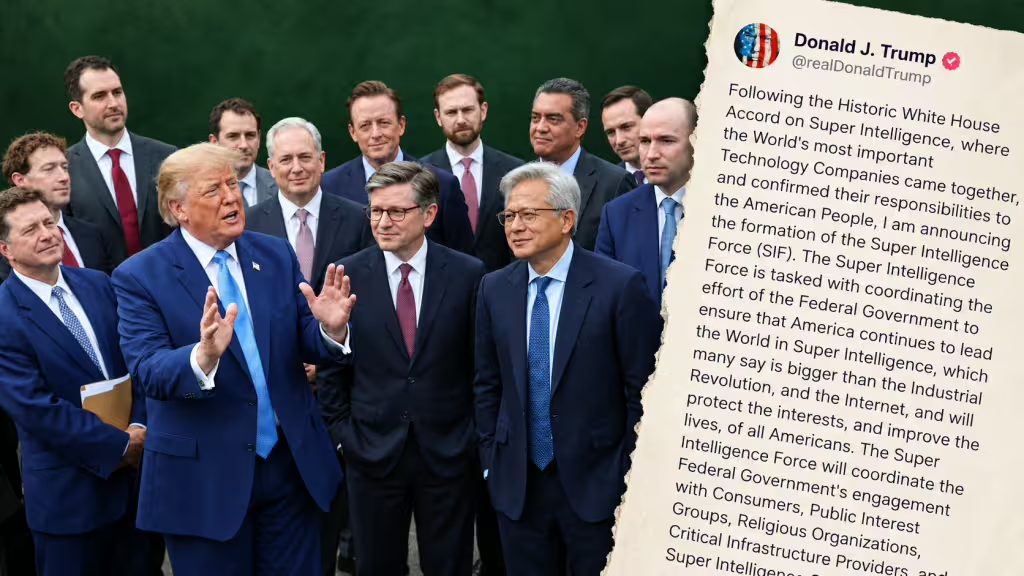
A new federal body called the Super Intelligence Force will coordinate the U.S. government’s work on superintelligence, President Donald Trump announced in a statement.
· Originally published by ontime+ · Last verified: 4 Oct 2026 (Nada Salam)
Key Points
- Trump announced a Super Intelligence Force to coordinate federal work on superintelligence across agencies.
- The body follows what he called a White House accord with major technology companies.
- Four senior officials will run it and report directly to Trump and Susie Wiles.
The latest:
A new federal body called the Super Intelligence Force will coordinate the U.S. government’s work on superintelligence, President Donald Trump announced in a statement. He tied the move to what he described as a historic White House accord in which leading technology companies affirmed their responsibilities to the American people. Four senior officials will lead it, reporting to Trump and Chief of Staff Susie Wiles.
Details:
- The mandate: Trump said the Super Intelligence Force, abbreviated SIF, is tasked with coordinating the federal government’s effort to ensure the United States continues to lead the world in superintelligence, and with protecting the interests and improving the lives of all Americans.
- The leadership: Trump named four officials to lead the body: Director of National Intelligence Jay Clayton, Federal Trade Commission Chairman Andrew Ferguson, Under Secretary of War for Research and Engineering and Chief Technology Officer Emil Michael, and Office of Personnel Management Director Scott Kupor.
- The reporting line: According to the statement, the force reports directly to the President and to Chief of Staff Susie Wiles. Trump did not describe a budget, a staffing structure, or how the four leaders would divide authority among themselves.
- Who it engages: Trump said the force will coordinate the federal government’s engagement with consumers, public interest groups, religious organizations, critical infrastructure providers, and superintelligence companies, placing faith groups and infrastructure operators alongside industry in the same consultation channel.
- The accord: The announcement is framed as a follow-up to what Trump called a historic White House accord on superintelligence, at which he said the world’s most important technology companies came together and confirmed their responsibilities to the American people. No participating company was named.
- The framing: Trump wrote that many say superintelligence is bigger than the Industrial Revolution and the internet, an assessment he attributed to unnamed others rather than stating as his own conclusion. The statement offered no technical definition of superintelligence.
- The agencies involved: The four named leaders come from intelligence, consumer protection, defense research and federal workforce management, spanning agencies that rarely share a single mandate. The statement did not say whether their existing roles continue alongside the new assignment.
- What was not set: Trump set no timeline for the force to begin operating, named no start date, and did not say whether the body requires congressional authorization or operates under existing executive authority.
Between the lines:
The composition of the leadership signals the breadth of the brief. Pairing the Director of National Intelligence with the FTC chairman places national security and consumer protection under one coordinating roof, while the inclusion of the Office of Personnel Management director points to a federal workforce dimension. The named engagement with religious organizations and critical infrastructure providers suggests the administration sees the file as social and operational, not only industrial.
What’s next
Watch for an executive order or formal charter defining the force’s authority, a first meeting or public schedule, named participants from the White House accord, and whether Congress seeks a role in authorizing or funding the body.