UAE positioned as architect of global AI order, report argues
A new report casts the UAE as a shaper of global AI standards, not just a participant.
· Last verified: 9 Oct 2026 (Mohammed Soliman, McLarty Associates)
Summary
- A new report casts the UAE as a shaper of global AI standards, not just a participant.
- It credits National AI Strategy 2031, Falcon models, MBZUAI and US-linked compute deals.
- The assessment frames AI as the core engine of post-hydrocarbon economic diversification.
The latest
The UAE has built a self-reinforcing AI system in which strategic vision, capital, talent and infrastructure compound into accelerating research and deployment, according to a report by Mohammed Soliman, director at McLarty Associates, published September 18, 2026. The analysis argues Abu Dhabi now helps set standards, deployment models and market dynamics. It does not assign a dollar value to the buildout.
Details
- The core thesis: Soliman argues the UAE's rapid scaling of AI capability makes it an emerging architect of the ecosystem rather than a participant in the race. He attributes this to simultaneous investment in infrastructure, talent and regulatory frameworks, which he says lets Abu Dhabi influence global standards.
- The economic case: The report places AI at the center of the shift from a hydrocarbon economy to a knowledge-driven one. It says AI is increasingly embedded in healthcare, national security, education and environmental management, and that deployment is becoming a measure of state performance.
- The strategy: National AI Strategy 2031 underpins the ambition, per the report. It cites the appointment of the world's first Minister of State for Artificial Intelligence in 2017, the founding of Mohamed bin Zayed University of Artificial Intelligence, the Dubai.AI platform and the Falcon AI models as markers of that build.
- The hardware: Soliman points to G42's Artemis cluster and supercomputers at the Technology Innovation Institute as the compute backbone for advanced research. He adds that securing NVIDIA's H100 chips demonstrates the strength of the US-UAE technology partnership, without disclosing the volume of chips involved.
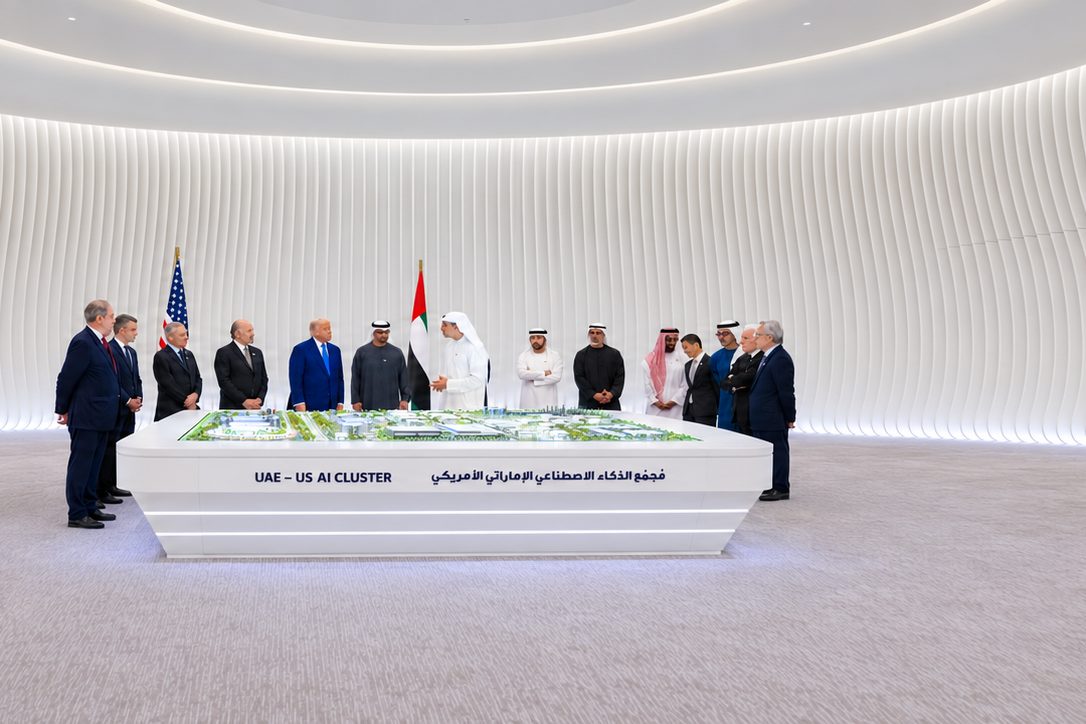
- The Washington link: Partnership with the United States is described as central, with MGX's infrastructure initiative alongside BlackRock and Microsoft, and the G42-Microsoft deal, cited as evidence. The report frames this as capacity-building coordinated with Washington while preserving a sovereign Emirati approach to technology.
- The regulation: The report credits RegLab and regulatory sandboxes covering information and communications technology and TradeTech with enabling dynamic rulemaking. Soliman says these frameworks support experimentation, lower barriers for startups, and keep the UAE aligned with global ethical standards.
- The talent pipeline: Educational reform, reskilling programs and MBZUAI are presented as the mechanism for preparing the Emirati workforce, with the Golden Visa named as the instrument for attracting international experts. No target figures for trained nationals or recruited specialists are given.
- The competitive map: Soliman assesses that China's AI ecosystem will retain strong ties to the Global South despite US containment efforts, posing a significant but surmountable challenge. He judges Europe at risk of setting global standards while failing to build competitive champions, leaving an opening between American scale and Chinese ambition.
- The war factor: In the context of the Iran war, the report says Abu Dhabi is pressing ahead with its compute buildout and deepening technology ties with Washington, supported by joint projects and the US-UAE AI Acceleration Partnership.
Background
The UAE created the first cabinet-level AI portfolio in 2017 and has since tied its diversification agenda to compute, chips and research institutions, with US firms as primary partners in the buildout.
Between the lines
The report's own logic links two claims that sit in tension: Emirati leverage comes from operating across geopolitical fault lines without capture by any one power, yet the compute, the chips and the flagship deals cited all run through Washington. Soliman's point that US firms cannot absorb global compute demand alone is what makes that dependence mutual rather than one-sided.
What's next
Watch delivery milestones under the US-UAE AI Acceleration Partnership, further NVIDIA chip approvals, and whether G42 and MGX announce new infrastructure projects as the Iran war continues.