UAE confirms tanker oil spill, closes all Umm Al Quwain beaches
All beaches and coastal areas in Umm Al Quwain are temporarily closed after the UAE Ministry of Climate Change and Environment confirmed a tanker oil spill off the emirate early on Friday.
· Originally published by ontime+ · Last verified: 23 Oct 2026 (Khaled Aziz)
Key Points
- UAE environment ministry confirmed a tanker oil spill reaching Umm Al Quwain's beaches, now closed to the public.
- Maritime agencies link the leak to the Gem No.2, hit in a suspected Iranian drone attack on October 9-10.
- Officials say the fuel odour across the northern emirates poses no health risk to residents.
The latest:
All beaches and coastal areas in Umm Al Quwain are temporarily closed after the UAE Ministry of Climate Change and Environment confirmed a tanker oil spill off the emirate early on Friday. The ministry said its technical monitoring system detected the leak, and that containment, cordoning and clean-up operations began immediately with local and federal authorities.
Details:
- The source of the smell: The ministry said the spill explains the strong fuel odour reported for days by residents of Dubai and the northern emirates. Odours noticed in Sharjah, Ajman and Umm Al Quwain pose no health risks, it said, while advising the public to stay away from any oil washing ashore.
- The vessel: The ministry did not name the tanker. International maritime agencies say the Gem No.2, a 330-metre supertanker, was struck in a suspected Iranian drone attack on October 9 to 10. Twenty-two Indian sailors were rescued from the vessel at the time of the strike.
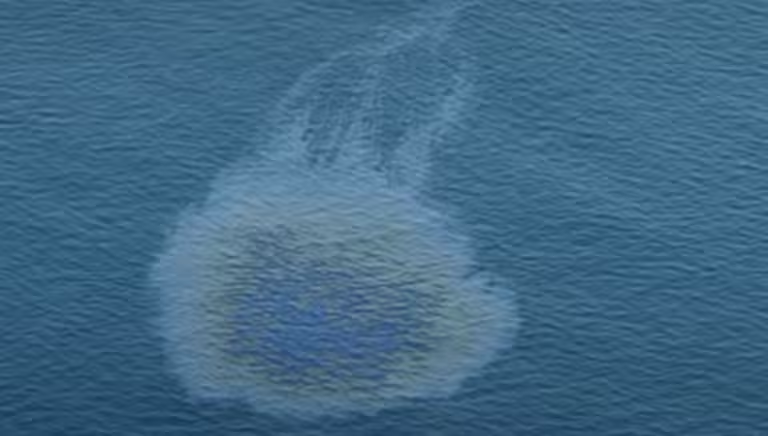
- The satellite evidence: An image captured by SAR radar on October 21 shows oil leaking from a tanker 25km off the coast of Umm Al Quwain, according to the European Space Agency. The ministry did not give an estimate of the volume spilled or the extent of the slick.
- The response: Teams began containment, cordoning, clean-up and remediation work with local and federal authorities to limit environmental impacts, the ministry said. Precautionary coastal surveys, monitoring and assessments are continuing to gauge the damage and protect the marine environment.
- Warning to fishermen: The ministry urged fishermen and other sea users to follow official instructions and avoid fishing in affected areas. It said the beach closures will remain until technical teams complete their assessments and identify safety and marine protection measures.
- How spills spread: Dr Diana Francis of Khalifa University in Abu Dhabi told The National that spilled oil keeps moving with currents unless fully removed, and can accumulate in rotating current areas. With time, heat and wind it evaporates into the air, producing the fuel-like odours residents reported.
- Why the smell travels: Prashant Kumar, professor of air quality and health at the University of Surrey, said such smells can travel tens of kilometres depending on meteorological conditions, wind speed and direction, and that long-range transport of pollutants from one place to another is easily possible.
- The wider file: Confirmation of the spill followed growing concern over the environmental impact of the Iran war on the Gulf and the Arabian Sea. Gulf states have been urged to address what has been described as unprecedented ecological damage across the region’s waters.
Background:
The Gem No.2 was hit during the Iran war, part of a wider pattern of maritime strikes that has raised alarm over shipping and pollution risks in the Arabian Gulf, one of the world’s busiest oil transit corridors.
Between the lines:
Two gaps stand out. The ministry has confirmed the leak without naming the vessel, leaving the link to the suspected October 9-10 drone attack to maritime agencies rather than official statements. And with no volume estimate published, the satellite image showing oil still leaking 25km offshore is the clearest available measure of a slick that, as Francis noted, will keep drifting until removed.
What’s next
Watch for the completion of the technical assessments that determine when Umm Al Quwain’s beaches reopen, any official volume estimate for the spill, and whether oil comes ashore on neighbouring Ajman and Sharjah coastlines.