UAE Orders 10,000-Plus Autonomous Taxis and Delivery Vans
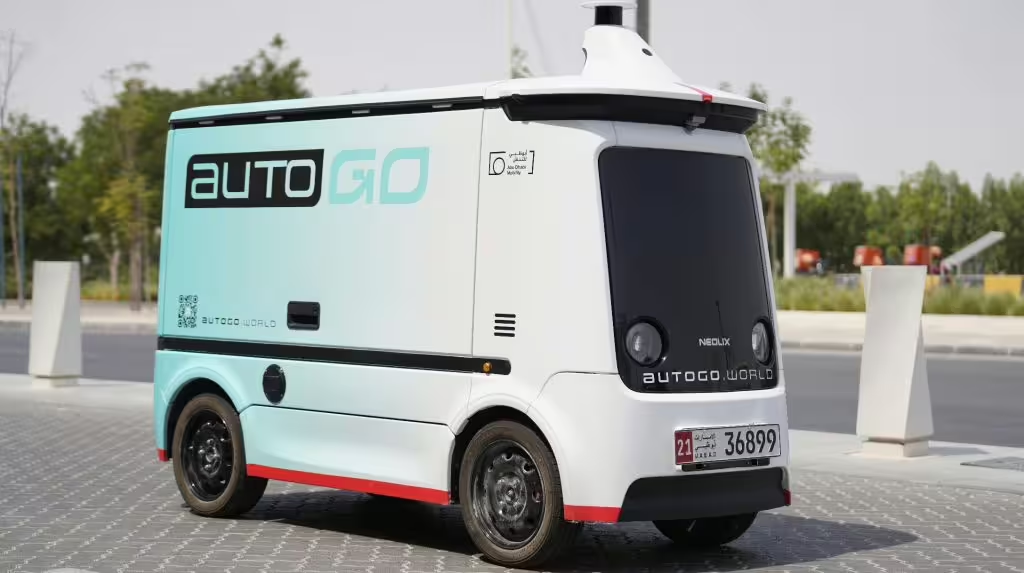
The latest More than 10,000 autonomous taxis and delivery vans are expected to enter service across the UAE next year, marking a shift from controlled trials toward mass commercial deployment.
· Originally published by ontime+ · Last verified: 6 Oct 2026 (Caroline Haiat)
Key Points
- The UAE has ordered more than 10,000 driverless taxis and delivery vans for deployment next year.
- Faisal Al Bannai said the expansion will move autonomous mobility beyond limited pilot projects.
- The rollout could make the UAE the largest deployer of such commercial vehicles outside China.
The latest
More than 10,000 autonomous taxis and delivery vans are expected to enter service across the UAE next year, marking a shift from controlled trials toward mass commercial deployment. Faisal Al Bannai, adviser to the UAE President and secretary general of the Advanced Technology Research Council, said orders had already been placed for the vehicles. Speaking Tuesday at AI Everything Abu Dhabi, he said the fleet would exceed 10,000 units and described the country as poised to become the largest deployer of autonomous taxis and delivery vans outside China.
Details
- Commercial foundation: Autonomous vehicles already operate commercially in Abu Dhabi and Dubai. Abu Dhabi has expanded Level 4 taxi services, allowing vehicles to run without a human driver within defined operating areas. Dubai has launched commercial operations in Umm Suqeim and Jumeirah. Abu Dhabi previously became the first MENA city to begin commercial operations with fully driverless Level 4 vehicles.
- Two-part rollout: The expansion covers passenger taxis and autonomous delivery vans, extending the technology into last-mile logistics, food delivery and commercial transport. The next phase shifts the emphasis toward deployment speed and scale after initial commercial operations established a working base.
- Physical AI: The broader strategy encompasses “physical AI,” systems that interact with and operate in the physical world. It includes autonomous vehicles, industrial robots, inspection equipment, surveillance and monitoring platforms, and machines designed for public or commercial settings. Al Bannai said thousands of robots could be operating nationwide next year.
- Visible machines: Robots are expected in inspection, monitoring and hospitality, with Al Bannai pointing to streets, shopping malls, residential compounds and other public environments as likely locations. He said their numbers would reach the thousands rather than the hundreds, making the expansion difficult to miss.
- Technology ecosystem: The government is also expected to announce companies working on what Al Bannai called frontier physical intelligence. The initiative forms part of the UAE’s effort to develop an ecosystem around AI-powered machines and build domestic capabilities alongside the adoption of autonomous technologies.
- Scaling demands: Moving from hundreds of vehicles to more than 10,000 will require reliable mapping, maintenance, charging infrastructure, fleet management, cybersecurity and regulatory oversight. The larger fleets will also test interactions with pedestrians, conventional traffic and increasingly complex urban environments. Connected cities, investment capacity and centralized transport regulation support the rollout.
Background
Abu Dhabi has invested heavily in AI infrastructure, research and sovereign technology capabilities, while Dubai has concentrated on applying AI to urban services, transport and government operations. Designated operating zones allow autonomous fleets to begin in controlled geographies before their boundaries expand.
What’s next
The key indicator will be whether the ordered fleet enters commercial service next year at the promised scale, alongside the expected announcement of companies developing frontier physical intelligence and the planned deployment of thousands of robots.