Can Riyadh keep its investment boom alive under missile fire?
· Originally published by ontime+ · Last verified: 14 Oct 2026 (SAFAA SUBHI)
The latest:
Chief executives of Exxon, Shell, Chevron and BP pulled out of the World Energy Council congress in Riyadh this week after missile attacks on King Khalid International Airport killed at least 17 people and wounded hundreds, The New York Times reported. Saudi authorities suspended commercial flights at the airport until further notice. Energy Minister Prince Abdulaziz bin Salman took the stage anyway.
Details:
- The disruption: Delegates rerouted flights to other airports and in some cases to other countries in the region, according to The New York Times. Organizers had expected more than 25,000 participants at the congress, which runs through Friday; actual attendance has not been disclosed. US Energy Secretary Chris Wright and Italy’s energy security minister addressed the hall by video link.
- The no-shows: Exxon Mobil chief executive Darren Woods and BP’s Meg O’Neill were among those absent. Several Gulf ministers and executives attended in person, including Kuwait Petroleum Corporation chief executive Sheikh Nawaf S. Al Sabah, who said in Riyadh that the company stands in solidarity with the Saudis under attack on their infrastructure.
- The minister’s line: Prince Abdulaziz declared on Monday that the word fear does not exist in the Saudi dictionary, and branded Riyadh the capital of energy security. He told delegates that energy security cannot be taken for granted, and that resilience is built before crises begin.
- The pipeline: Prince Abdulaziz highlighted the rapid restart of the East-West pipeline, briefly shut in September after a drone attack launched from Iraqi territory. He said the kingdom plans to expand capacity to roughly 10 million barrels per day from a current maximum of 7 million.
- The export squeeze: Saudi Arabia lost much of its access to the Strait of Hormuz once Iran began using force to control shipping, The New York Times reported. When Riyadh shifted exports through the Red Sea pipeline, Iran-backed militias in Iraq struck that route too, leaving the kingdom’s main outlets under pressure simultaneously.
- The regional damage: The war with Iran, now in its eighth month, has hemmed in UAE ports behind a maritime combat front and badly damaged Qatar’s liquefied natural gas facilities supplying large parts of Asia. Iran has fired hundreds of missiles and drones at Gulf states hosting US military bases.
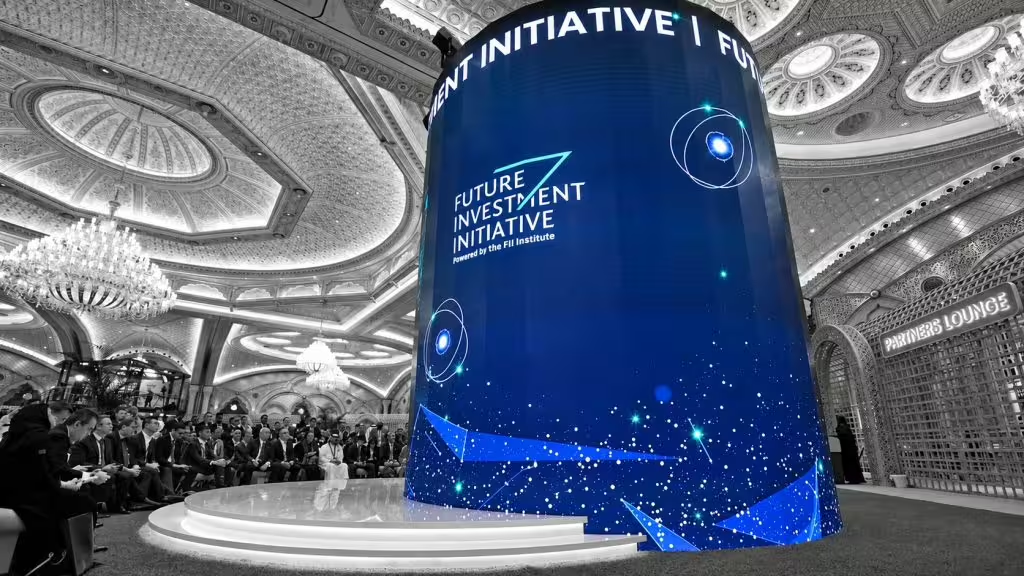
- The next test: Riyadh is due to host the Future Investment Initiative on October 26-29, chaired by Crown Prince Mohammed bin Salman. Organizers said on Tuesday the summit will proceed as planned, promising comprehensive security measures including transport assistance. Whether prominent chief executives will feel safe enough to attend remains unresolved.
- The analysts: Yousef M. Alshammari, head of the London College of Energy Economics, said keeping events on schedule preserves confidence, and without confidence foreign investment becomes hard to attract. Neil Quilliam of Chatham House said cancelling would hand the Houthis a psychological victory, while warning that symbolism has limits.
- The backdrop: The congress was originally set for April and postponed after the United States and Israel struck Iran on February 28, igniting the wider conflict. Held every three years since the 1930s, this is the first time Saudi Arabia has hosted it, at a venue roughly 16 kilometers from the airport.
Background:
Vision 2030 is Mohammed bin Salman’s program to diversify the Saudi economy away from oil and turn the kingdom into a global destination for trade, sport, technology, culture and tourism. The FII summit, nicknamed Davos in the Desert, is its main showcase for world leaders, billionaires and fund managers.
Between the lines:
The stakes run beyond one conference. Riyadh has absorbed the loss of Hormuz access and an attack on its Red Sea alternative while still profiting from high prices, so the immediate threat is less to barrels than to the financial-hub ambition. Quilliam’s assessment points the same way: each cancelled appearance suggests the attacks are working on the economic transformation itself.
What’s next
The FII summit on October 26-29 is the clearest test: whether global chief executives attend in person, and whether Riyadh keeps the schedule intact. Also watch the East-West pipeline expansion toward 10 million barrels per day.