Dubai index closes at multi-month high as Gulf markets advance
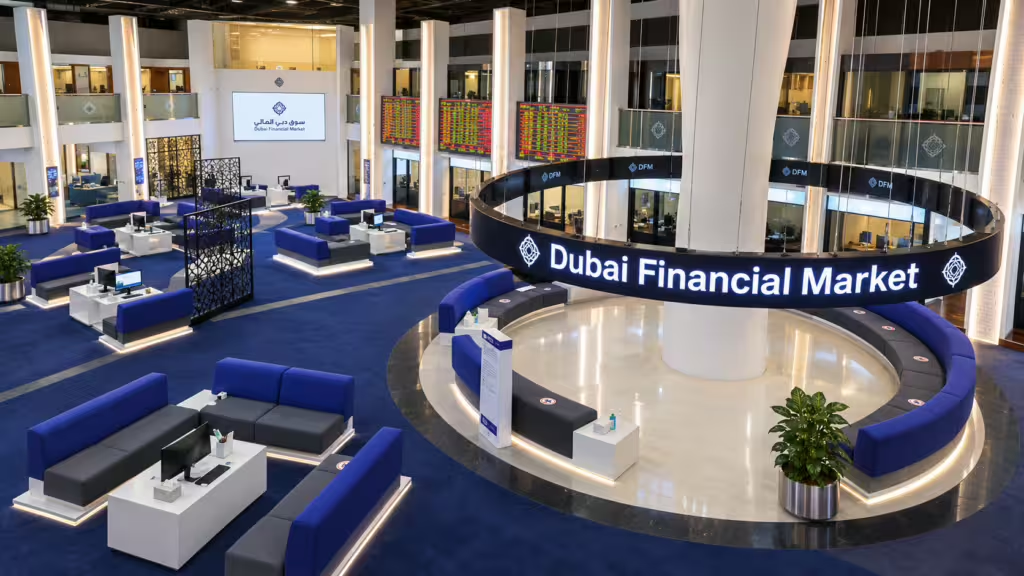
Dubai’s benchmark index climbed 61.92 points to 6,087.47 on Monday, a 1.028% gain that marked its strongest close since at least the start of August 2026, according to DFM historical data. Saudi Arabia’s main index added 89.80 points to 10,106.72, while Abu Dhabi and Kuwait also closed in positive territory.
· Originally published by ontime+ · Last verified: 9 Nov 2026 (Khaled Aziz)
Key Points
- Dubai's main index rose 1.028% to 6,087.47 points, its highest close since at least early August.
- Saudi, Abu Dhabi and Kuwait indices also finished Monday higher; Muscat was the sole decliner.
- Broad-based gains across four Gulf exchanges point to synchronized regional buying rather than a single-market move.
The latest:
Dubai’s benchmark index climbed 61.92 points to 6,087.47 on Monday, a 1.028% gain that marked its strongest close since at least the start of August 2026, according to DFM historical data. Saudi Arabia’s main index added 89.80 points to 10,106.72, while Abu Dhabi and Kuwait also closed in positive territory. Muscat was the only Gulf market to retreat.
Details:
- Dubai volumes: The Dubai Financial Market reported total turnover of roughly 1.06 billion dirhams across 17,128 transactions on Monday. The 1.028% advance in the DFMGI was the largest percentage gain among the Gulf indices that reported closing data for the session.
- Saudi main market: Tadawul’s main index closed up 89.80 points at 10,106.72, with turnover of 4.2 billion Saudi riyals, the Saudi Press Agency reported. A total of 252 million shares changed hands, with 179 companies advancing against 80 decliners — a breadth reading that points to broad buying.
- Saudi parallel market: The Nomu parallel market moved against the main board, shedding 55.25 points to close at 21,686.57, according to the Saudi Press Agency. Turnover there was 18.2 million riyals, a fraction of the main market’s activity, underlining the segment’s far thinner liquidity.
- Abu Dhabi indices: The FADGI general index rose 90.49 points, or 0.963%, to 9,483.09, per Abu Dhabi Securities Exchange data. The blue-chip FADX15 gained 111.95 points, or 1.118%, to 10,127.25, while the FADGMI added 2.88 points, or 0.626%, to 462.92.
- Abu Dhabi turnover: Total value traded on ADX reached about 1.53 billion dirhams across 30,903 transactions, the highest reported turnover among the Gulf exchanges that published figures for the session. That was roughly 44% more than the value traded in neighbouring Dubai on the same day.
- Kuwait breadth: Kuwait’s all-share index closed up 24.22 points, or 0.28%, at 8,524.50, the Kuwait News Agency reported. All four sub-indices rose: the Main Market added 0.58%, Premier 0.23%, and Main 50 gained 0.41% to 9,514.41 points.
- Kuwait volumes: Trading on Boursa Kuwait covered 331.9 million shares through 20,828 cash transactions worth 80.9 million Kuwaiti dinars, or about 249 million dollars, according to the Kuwait News Agency. The index’s 0.28% rise was the smallest percentage gain among the four advancing markets.
- Muscat the outlier: The MSX30 fell 30.285 points, or 0.420%, to 7,233.943 — the only Gulf benchmark to decline. Turnover reached 27.4 million Omani rials across 13,048 transactions, with 30 companies falling, 14 rising and 18 unchanged, Muscat Stock Exchange data showed.
- Markets not reporting: Closing data for the Qatar Stock Exchange, Bahrain Bourse and the Iraq Stock Exchange were not available at the time this report was prepared, leaving three regional markets outside Monday’s picture.
Between the lines:
The gains were not concentrated in one exchange: Dubai, Abu Dhabi, Riyadh and Kuwait all closed higher on the same session, and in Kuwait every sub-index advanced while Saudi breadth ran better than two advancers for each decliner. Muscat’s 0.420% slip, with 30 decliners against 14 gainers, looks like a local divergence rather than a regional turn.
What’s next
Watch Tuesday’s opening for Dubai to confirm or surrender the 6,087 level, and whether closing data resume publishing for Qatar, Bahrain and Iraq, which would complete the regional picture.