Gulf oil exports top prewar levels despite Iranian attacks on tankers
Oil leaving the Persian Gulf has climbed past prewar levels, with Middle East flows averaging more than 24 million barrels a day in the week through Oct. 18 against 23.3 million before the war, ship tracker Kpler said. An improvised convoy system operating under U.S.
· Originally published by ontime+ · Last verified: 21 Oct 2026 (Khaled Aziz)
Key Points
- Middle East oil flows averaged over 24 million barrels a day through Oct. 18, beating prewar levels.
- About 30 attacks on ships were reported this month around the Strait of Hormuz.
- Traders warn the improvised, costly shipping system could collapse if fighting escalates again.
The latest:
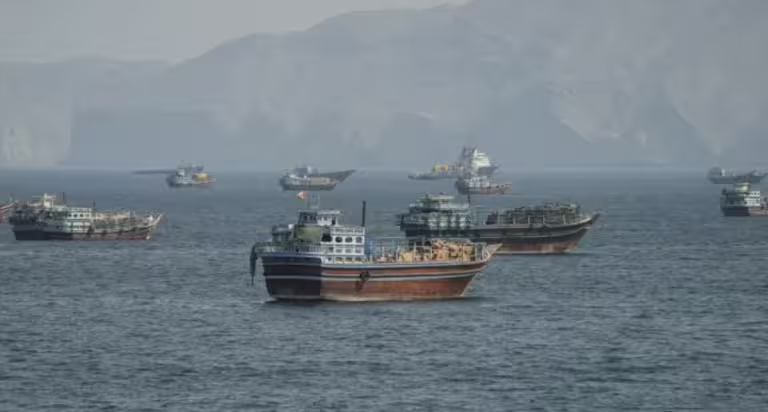
Oil leaving the Persian Gulf has climbed past prewar levels, with Middle East flows averaging more than 24 million barrels a day in the week through Oct. 18 against 23.3 million before the war, ship tracker Kpler said. An improvised convoy system operating under U.S. air cover is carrying crude through one of Iran’s heaviest waves of attacks on shipping in the Strait of Hormuz.
Details:
- The Hormuz figure: Preliminary Kpler data put oil flows through Hormuz, including offshore transfers in the Gulf of Oman, at around 14 million barrels a day over the same period, roughly 82% of prewar levels. The overall recovery is being carried partly by routes that avoid the strait altogether.
- The bypass routes: Pipelines across Saudi Arabia and the United Arab Emirates are moving crude along alternative paths. Kpler estimated that in September about 40% of non-Iranian crude shipped out of the Gulf bypassed the strait, compared with 17% before the war, a sharp rerouting of regional export infrastructure.
- The attacks: About 30 attacks on ships were reported this month, according to a Wall Street Journal tally based on reports from the U.K. Maritime Trade Operations Centre and maritime security firms. Michelle Wiese Bockmann of Windward said October alone accounts for 20% of all ships attacked during the war.
- Iran’s tactics: The Islamic Revolutionary Guard Corps is using drones and missiles against ships attempting the crossing, according to the report. It has also adopted guerrilla methods long used by Yemen’s Houthis near the mouth of the Red Sea, deploying spotters in small fishing boats and sending fighters onto the water.
- The economics: Homayoun Falakshahi, Kpler’s head of crude oil analysis, estimated traders can earn $20 a barrel more reselling Iraqi oil than before the war, roughly $40 million on a supertanker cargo. Three such voyages could repay the $100 million cost of a secondhand tanker.
- Crew bonuses: Seafarers are being offered payouts two or three times their usual monthly salary to sail into the Persian Gulf. One China-based ship-staffing company offered as much as $25,000 for a round trip that normally takes one or two weeks, the Journal reported.
- How it works: Tankers load inside the Gulf and cross Hormuz, often with tracking signals switched off, under American air cover along a corridor near the Omani coast. They transfer cargo near Oman to vessels bound for distant markets, then return into the Gulf, where the risk of being hit is highest.
- One ship’s run: The Tanzania-flagged supertanker Loyalty, previously carrying Venezuelan crude to China, entered the Gulf twice since September to load Iraqi oil. A crew member said the ship notified the U.S. Navy before each trip, carried security personnel, and received body armor and helmets from its management company.
- The strike: On Oct. 16, Loyalty was hit by a rocket-propelled grenade fired from a small boat, maritime security company Vanguard said. The projectile punched a hole in a fresh water tank. The vessel was carrying 2 million barrels of Iraqi crude at the time, according to a crew member.
- The cost: Freight for a supertanker carrying Gulf crude to China neared a record $37.37 a barrel this week, Kpler said. War-risk insurance has climbed to as much as 10% of a vessel’s value from under 3%, Wiese Bockmann said. Brent crude traded near $108 a barrel Tuesday.
Background:
Iran had threatened that if it could not export its own oil, it would not allow neighbors to ship theirs. Its exports are now bottled up by a U.S. maritime blockade, while Gulf producers continue loading cargoes through the strait.
Between the lines:
Hamad Hussain of Capital Economics assessed that the shipping system through a dangerous Hormuz is now well established and exporters’ risk appetite has risen, adding that Iran would need to be far more aggressive to regain its former control over regional flows. With bypass pipelines carrying 40% of non-Iranian Gulf crude and tankers crossing under U.S. air cover, Tehran’s leverage has narrowed to raising costs rather than halting trade.
What’s next
Watch whether Iran escalates ahead of the U.S. midterm elections in two weeks, further attacks on tankers in the Gulf of Oman corridor, and movement in Brent prices and war-risk insurance rates.