Medical tourism in the Gulf: the foreign partner tripled its money, the hospital barely broke even
Mayo Clinic sold its Abu Dhabi stake for 150 million dollars, three times its cash investment.
· Last verified: 1 Oct 2026 (Dubai Health Authority; Cleveland Clinic Abu Dhabi; Mubadala; Mayo Clinic; PureHealth disclosure to Abu Dhabi Securities Exchange; Hamad Medical Corporation; King Faisal Specialist Hospital; Qatar Tourism; finance ministries of Saudi Arabia, the UAE and Oman; Qatar Government Communications Office; Saudi Ministry of Health)
Summary
- Mayo Clinic sold its Abu Dhabi stake for 150 million dollars, three times its cash investment.
- Gulf states are building branded hospitals to attract patients and keep citizens' treatment spending at home.
- The hospital itself earned a margin below 1%, showing returns sit outside the medical bill.
The latest
Mayo Clinic exited its Abu Dhabi joint venture in January 2024 for 150 million dollars, three times the 50 million it paid in cash four years earlier for a partnership planned to run two decades. The deal valued Sheikh Shakhbout Medical City at 600 million dollars, while Gulf medical tourism revenue keeps climbing on branded American hospitals financed by local capital.
Details
- Dubai revenue: Medical tourism income in Dubai rose about 15% in 2024 against the previous year, according to the Dubai Health Authority. The last absolute figures the authority published date to 2023: 691,478 medical tourists who spent more than 1.034 billion dirhams on health services.
- The multiplier: The same 2023 report recorded 2.3 billion dirhams in indirect revenue flowing to airlines, hotels and telecoms. Every dirham spent on treatment generated more than two dirhams outside the hospital walls, placing the economic return well beyond clinical billing.
- Abu Dhabi volumes: Cleveland Clinic Abu Dhabi treated roughly one million patients in 2025. It received more than 10,000 international patients in 2024, a 34% increase, followed by a further 20% rise in 2025. The hospital sits inside M42, launched by Mubadala and G42 in 2023.
- The ownership split: Capital is local, brand and expertise are American. In Dubai, the American Hospital joined the Mayo Clinic Care Network in 2016 as the first Middle East member, a knowledge partnership granting consultation and protocols while ownership stayed with a local group.
- Saudi and Qatar: King Faisal Specialist Hospital reported 47% growth in international patients during 2024. In Qatar, the field combines Hamad Medical Corporation and Sidra Medicine, which Qatar Tourism promotes among its institutions receiving international patients.
- Budget firepower: Saudi Arabia allocated 259 billion riyals to health and social development in its 2026 budget, Qatar set aside 25.4 billion riyals for health, and the UAE committed 5.7 billion dirhams at the federal level alone.
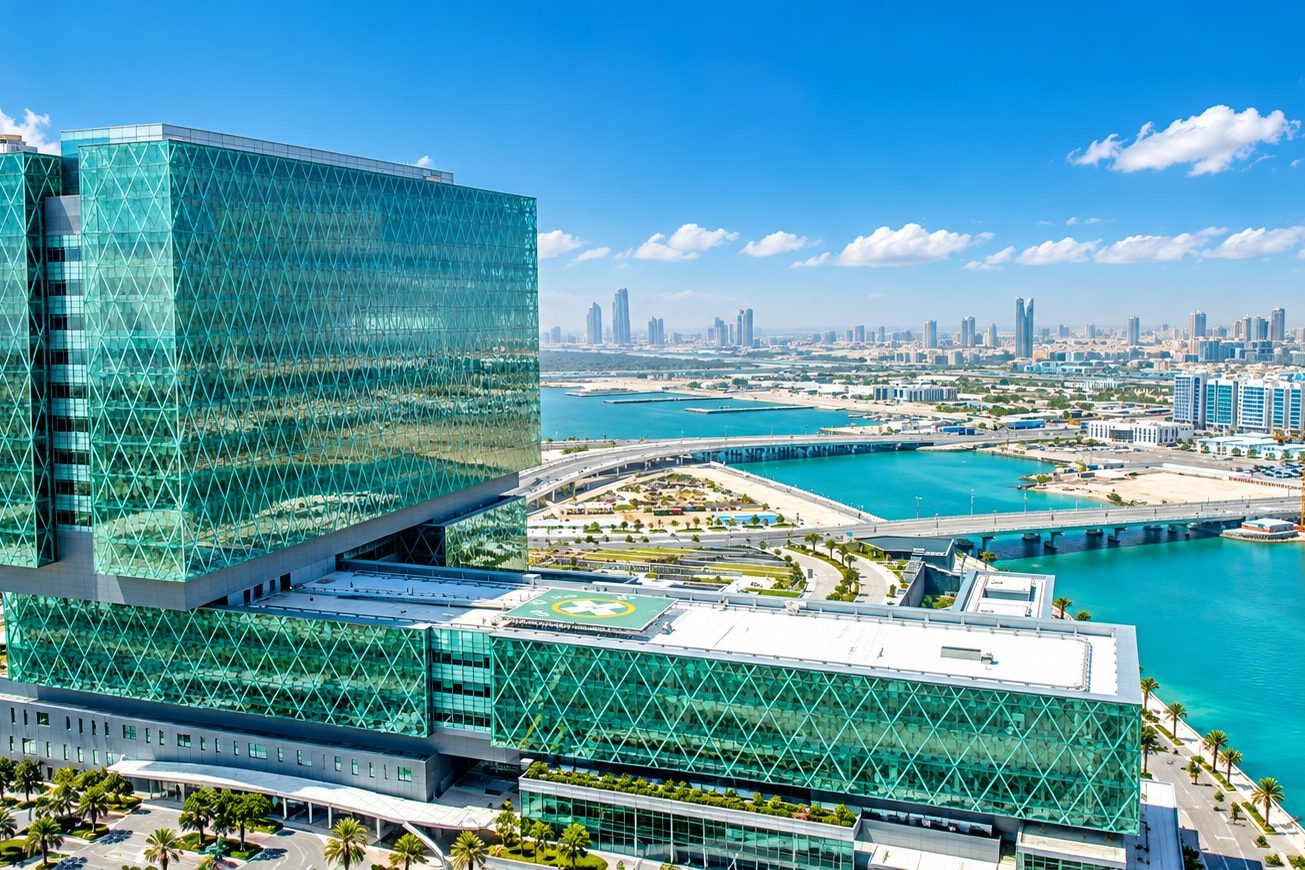
- The Mayo entry: Mayo Clinic entered in 2019 as a partner in Sheikh Shakhbout Medical City, the UAE's largest hospital with 741 beds, in a joint venture with SEHA. In 2020 it paid 50 million dollars in cash, alongside intangible assets of expertise and brand, for a 25% stake.
- The thin margin: In 2023, the last year before ownership passed entirely to SEHA, the hospital posted net profit of 14.7 million dirhams on revenue of 2.15 billion dirhams, a margin under 1%.
- Buying assets: Gulf health capital shifted from buying expertise to buying assets. PureHealth acquired Circle Health, Britain's largest private healthcare group, for 1.2 billion dollars in January 2024. Saudi Arabia targets raising private sector participation in health to 65% by 2030 under Vision 2030.
- Market estimates: Research firms diverge so widely on the size of the Gulf market that no single number holds: estimates for 2025 range from 371.5 million dollars to 9.6 billion dollars.
Between the lines
The paradox runs wider than one deal. Hamad Medical Corporation publishes a list of preferred international hospitals for treating its patients abroad, led by Cleveland Clinic and Mayo Clinic. American brands open Gulf branches while the Gulf still pays their home campuses. Oman alone spends OMR 14.47 million a year on overseas treatment, per its 2024 final account. The real return is the patient who stayed home.
What's next
Dubai has not yet published medical tourist numbers for 2024 and 2025. The decisive indicator is net spending the region retains from overseas treatment plus new spending attracted, a figure no Gulf state has published comprehensively.
Source: Dubai Health Authority; Cleveland Clinic Abu Dhabi; Mubadala; Mayo Clinic; PureHealth disclosure to Abu Dhabi Securities Exchange; Hamad Medical Corporation; King Faisal Specialist Hospital; Qatar Tourism; finance ministries of Saudi Arabia, the UAE and Oman; Qatar Government Communications Office; Saudi Ministry of Health