UAE and Saudi Arabia sign rail and power interconnection memorandum in Riyadh
Rail connectivity between the UAE and Saudi Arabia moved onto a formal track Thursday with a memorandum of understanding signed in Riyadh, covering freight movement, logistics integration and electricity trade.
· Originally published by ontime+ · Last verified: 8 Oct 2026 (Khaled Aziz)
Key Points
- The two states signed a memorandum in Riyadh on rail links, cargo movement and electricity interconnection.
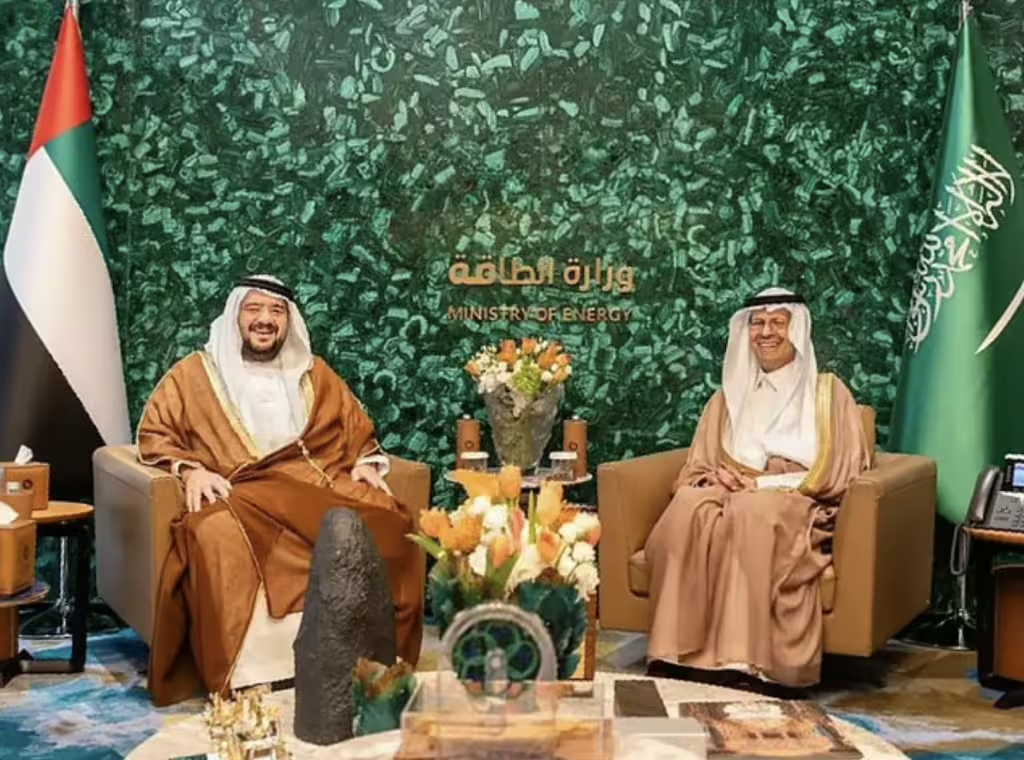
- Signatories were UAE Investment Minister Alsuwaidi and Saudi Energy Minister Prince Abdulaziz bin Salman.
- The document commits both sides to feasibility studies rather than to construction or a funding package.
The latest:
Rail connectivity between the UAE and Saudi Arabia moved onto a formal track Thursday with a memorandum of understanding signed in Riyadh, covering freight movement, logistics integration and electricity trade. UAE Minister of Investment Mohamed Hassan Alsuwaidi signed for Abu Dhabi, and Prince Abdulaziz bin Salman, Saudi Minister of Energy and Minister of Industry and Mineral Resources, signed for Riyadh, according to WAM.
Details:
- The signatories: The UAE side was represented by Mohamed Hassan Alsuwaidi, Minister of Investment, and the Saudi side by Prince Abdulaziz bin Salman bin Abdulaziz, who holds both the energy portfolio and the industry and mineral resources portfolio. The signing took place in Riyadh on Thursday, WAM reported.
- The rail component: The memorandum sets out general principles for rail connectivity between the two countries and aims to facilitate the movement of goods and cargo, according to WAM. It is framed as a step toward infrastructure and energy-sector integration serving what the two governments describe as shared economic interests.
- What is actually committed: Rather than authorising construction, the document provides for technical and economic studies intended to support logistics integration, improve supply-chain efficiency and ease cross-border trade and transport, WAM reported.
- The electricity track: Alongside rail, the memorandum covers cooperation on electricity interconnection and on the exchange and sale of power between the two markets, turning a transport agreement into a dual infrastructure file that links freight corridors and cross-border energy trade in one document.
- Feasibility work: The electricity component includes technical, economic and environmental feasibility studies to assess interconnection opportunities, according to WAM. Environmental assessment is named explicitly alongside the commercial and engineering reviews, indicating the two sides expect a formal study phase before any build decision.
- The GCC dimension: The memorandum provides for coordination with Gulf Cooperation Council member states on expanding the Gulf electricity interconnection system, WAM reported. That places the bilateral arrangement inside an existing multilateral grid rather than treating it as a standalone Abu Dhabi–Riyadh link.
- Stated goals: Both governments present the package as supporting energy-system efficiency and enhancing regional connectivity, with language framed around supply-chain performance and grid capability rather than any single project, route or terminal.
- Unspecified elements: The announcement did not name a route, a timeline, a cost estimate or the entities that will carry out the studies. No start date for the feasibility work was given, and no target date was set for a decision on whether a rail link or a new interconnector proceeds.
Background:
The Gulf electricity interconnection system already links GCC member grids, and a Gulf-wide railway network has been under discussion among member states for years. The new memorandum attaches a bilateral UAE–Saudi track to both of those existing regional frameworks.
Between the lines:
Bundling rail and electricity into one memorandum signals the two capitals are treating transport corridors and power trade as a single integration file rather than separate negotiations. But the operative commitments are studies — technical, economic and environmental — the stage before capital allocation, not after it. With no route, cost or timeline named, the agreement’s weight will be measured by what the feasibility work produces.
What’s next
Watch for the launch of the technical, economic and environmental feasibility studies, the naming of implementing entities, and any GCC-level decision on expanding the Gulf electricity interconnection system to accommodate the proposed links.